Musings

All the Marathis

My first exposure to Vijaywada and the language environment of my new home was a conversation with the uber driver. We interacted with help of our mixed repertoire of English and Telugu. I do not speak Telugu (yet). He taught me some useful everyday terms. I told him about Telugu I have heard in Hyderabad. Then the conversation moved to the different Telugu s. The Vijayawada Telugu is the pure Telugu he said and then proceeded to explain the differences with other regional versions with everyday examples. The forms of verbs, the intonations, some words that differ.

That conversation stayed with me because it made me think about a similar possible conversation with a Puneri person. Many times Marathi Praman Bhasha is equated with the formal register. However, there is an added layer of regional hierarchy. The Puneri Marathi and its formal register are Praman. The formal register of the languages in other regions are still not up to the mark.

When I refer to formal register I am talking about language spoken at formal occasions rather than everyday speech. Formal does not mean pure. It only means situational. Other registers could be spoken vs. written. Then there is the difference between written to friends, colleagues, boss, vs government/official/legal notes.

These registers are just the way we speak/express depending on where we are and who we are speaking to. It is not about correct or incorrect language. The problem starts when we see it as a hierarchy and treat one register as ‘proper’ or shuddh शुद्ध (pure) language. In doing so we have forgotten the regionality of the Puneri Marathi register.

If Praman Bhasha were truly neutral, who would feel most at home in it—and who would feel most exposed? Puneri Marathi quietly standing in as neutral or pure or the original untainted marathi, makes distinctions between registers not just functional. They are moralised. Speaking or writing differently is no longer just “informal” — it becomes “lazy”, “incorrect”, or “uncultured”.

Thus when a child, a teacher, or a community speaker is told their Marathi is ashuddh अशुद्ध, what is really being corrected is not grammar but location, physical and social.

Related Reading:
All the Englishes by Akshaya Saxena: She talks about helping students in her literature class question “how language itself shapes our ideas about ownership and belonging” with the help of Amy Tan’s essay ‘Mother tongue’.
Musings · Social Media, Technology & Education

Contrasting Realities

This year again I was in Harali, working with Anandshala facilitators, when the editorial work for the Technology in Education issue of the IAFOR Journal of Education was at its peak. This year, similar to last year we had a lot of papers on AI. Some of them got through the peer review process and are published in the latest issue.

As we review various papers on AI, the discourse focuses on subjects such as evaluation challenges as AI becomes ubiquitous etc. as well as unexpected topics such as AI assisted plush toys/robots for children with autism. Here at Harali, I see student circumstances many generations behind this fast moving world. The cognitive dissonance is jarring.

Juggling the two drastically different contexts I inhabit, one with cutting edge technology and other with nomadic community in a disadvantaged district made me think of the socio-political context of educational technology. The editorial introduction this year focused on the ‘critical turn’ in educational technology is inspired by this experience.

Musings

The Need to Pass

Yesterday one of the speakers at the Vimukt Diwas conference mentioned how some Banjara (or DNT?) youth borrowed money to go to Ayodhya for the Ram mandir inauguration, while the families did not have enough money for two square meals or to continue their education. What makes people make these decisions?

There was a discussion on false consciousness and how this keeps DNT in the cycle of poverty and exploitation. The point of the conversation was that people are misled by dominant ideologies into acting against their own interests. However, instead of asking why do people act against their interests? I would like to think what kinds of recognition are made available to them, and at what cost?

I have been thinking about this for the past few years with reference to the conversations in the Anandshala project. Two conversations stand out:

When interviewing Banjara students about their language use, one student said, it is obvious that nobody would like to learn his language, it is filthy. There are swear words. Marathi is much cleaner. The remark was delivered in a matter of-fact way.

A few months back waiting for the inauguration ceremony of Anandshala container school in a vadar vasti, I was chatting with the parents and grandparents of the children. One grandma mentioned that she just dropped her grandson in a residential school. Among the two, one was very boisterous and unruly. She was worried about वाईट संगत if he stayed home. The other one was quieter, brighter. अगदी बामनावाणी बोलतो. The teacher at the residential school promised that he will straighten the boisterous one after a year, after he gives him time to settle down.

These are not isolated anecdotes. The pressure on marginalised communities to demonstrate worthiness by aligning themselves with dominant norms of speech, behaviour, belief, and discipline are evident in everyday moments as well as institutional processes. Hegemony works not through force alone, but through consent: through everyday practices of aspiration and common sense.

These three instances are examples of investments in symbolic capital. Attempts to convert marginality into recognition, however fragile that recognition may be. The problem is not that people want to pass. It is that passing has been made a prerequisite for dignity.

Musings

What does it take to pass?

One of the Anandshala facilitators during a conversation proudly shared that people say “you don’t sound Laman”. For her, not sounding x is a marker of upward movement socially. Like in Shaw’s Pygmalion or P L Deshpande’s Fulrani, what does it take for a flower girl to pass off as an elite lady?

She grew up in the district headquarter, not in the Tanda. Her Marathi is learnt as a Parisar Bhasha among various marathi speaking people, not as a language of instruction or a subject in school like her students. For a person visiting from Pune, the keeper of ‘standard Marathi’ she will sound rural or not (so called) higher caste. Markers such as न and ण would be obvious to them. Those she did not learn by osmosis in her semi-urban environment, but only in the school. When we look at language as performative in that sense – where and how one learns it makes or breaks the performance.

Why do people find the need to pass; what harm such compulsions rooted in social structures cause; and what can we do personally and as a society to not put that burden on them is a conversation for another day.

Musings

Social Memory of Separation

The Girl’s hostel at the school (in Harali) started hosting Laman Banjara girls during the pandemic. Our Anandshala program at that time catered to the children of Banjara migrant workers. Come Diwali they migrate to harvest sugarcane and are away till February/March. With the AshramShalas still closed, young kids especially girls would have migrated with parents and all the efforts to keep them in school with help of Anandshala project would have been wasted. So the school temporarily accommodated banjara students in the hostel for 3-4 months. Then many of them joined the school and stayed on for the next year.

Visiting days and times for the girl’s hostel are fixed but Banjara parents arrive to see their children at ‘random’ times. Because they missed them intensely. Or because they thought of the kid while eating mutton curry. Or because they are leaving for the harvest and do not know when they will be back. Some reasons seem somewhat logical to the school staff, some outright absurd. Some staff members felt that the parents just don’t understand or do not want to follow rules.

For the last couple of years, the school started a scholarship program for bright girls to join the school in 5th grade and stay in the hostel. Most of the girls who got the scholarship did not join. Their mothers or grandmothers got emotional with the thought of parting. They are from within a 25 km radius of the school. It is not excruciatingly difficult to travel. One of the grandmothers said “She will get married and leave, why send her away now, so soon.”

This is unfathomable for the facilitators and JPH staff who worked hard to prepare these students for the ‘opportunity’. Some of the staff are urban and some are from the villages around. But neither could relate to this angst. It comes from the history of the community as nomad traders. In olden days, when a person joined another Tanda (a caravan) or got married and moved in a different direction, the probability that they will meet again was low, given that both of them would be on the move. This separation angst from the social memory is kept alive through wedding songs describing parting and loss.

In modern times, the girls get married to somebody within the community, many times in the same Tanda or nearby. But the historical memory and separation anxiety plays up in seemingly illogical ways affecting many facets of their life. You can’t wish it away or juxtapose a structure of another system on it to keep it in check.

Unless it is acknowledged, we can’t move forward.

In Harali, this is a constant struggle. Would bussing in be better to provide opportunities for Banjara girls, acknowledging the socio-cultural milieu? How can we make rules that work with the ways of the community?

Musings · Social Media, Technology & Education

मातृभाषा Mothertongue and Medium of Instruction

When talking about medium of instruction NEP2020 mentions mothertongue in conjunction with other languages – “home language/mother tongue/local language/regional language”. Mothertongue is thus casually equated to the regional language when it comes to classroom practice. This discourse many times skirts the usage of minority languages, giving primacy to named local or regional languages.

An interesting dialogue with a student at Harali shows how the confusion or ‘taking for granted’ is not just in the policy but has also entered the discourse on the ground:
तुझी मातृभाषा काय? [What is your mothertongue?]
मराठी [Marathi]
आईशी कुठल्या भाषेत बोलतोस? [In which language do you speak with your mother]
बनजारी [Banjari]

Musings · Social Media, Technology & Education

Endangered Home Languages

Working with the Laman Banjara children in Anandshala, we have been exploring various facets of the problem आपली मुलं शाळेत फुलत का नाहीत? [why don’t our children prosper in school]. A couple of years back we talked with the parents, children, and the teachers about language transition from home language to school language – their experiences, what they think works and does not work.

As educators, learning scientists, linguistic anthropologits, we think that it is important to support the home language. Use it in verbal exchange in formal and informal learning spaces; create learning material in the home language; encourage translanguaging. While parents want their children to quickly move on to Marathi and English. When asked “don’t you worry you will lose your language?” The answer was – “We talk in our language at home. It will not disappear. But the children need to learn English to get a job in the office and change their plight.”

An article on Kolami speaking community in PARI reminded me of this exchange. Kolami is named as an endangered language by UNESCO. But the speakers have more pressing issues than saving their language:

“There is no time to think about anything else [other than her farm],” she says about the status of Kolami as an endangered language. When Sunita and her community didn’t know fluent Marathi, “everyone would say ‘speak in Marathi! speak in Marathi!’” And now when the language is endangered, “everyone wants us to speak in Kolami,” she chuckles.
“We speak our language. Our children too,” she asserts. “It’s only when we go out that we speak in Marathi. When we come back home, we speak our language.”
“ Aapli bhasha aaplich rahili pahije [Our language should remain ours]. Kolami should be Kolami and Marathi should be Marathi. That is what matters.”

The Kolami Speakers of Yavatmal.

It is the exact same discourse. When there is urgent need of improving dire living situation, saving home language or the identity formation of the child in the first five school years based on home language, and all the theories of learning are not a priority.

Working with the community as a participatory practice rather than an intervention, where do we stand when our beliefs about primacy of home language butt against the basic struggle to stay alive?

Musings

निसर्गातली लगबग

रोज आंघोळ करताना खिडकीतून एक सुगरणीचं जोडपं घरटं करताना दिसतं. सुरवातीला नुसतं फांदीला लटकलेला अर्धगोल होता आता पूर्ण गोळा तयार झालाय. त्याला आत जायला जागा आणि त्याला वरून आवरण आहे. काडी काडी आणून, रोज थोड थोड करून अगदी सुबक बांधकाम झालंय.
जागोजागी शिंपी सुद्धा गवताची पाती आणून खोपच्यामध्ये घरटी बनवताहेत. एक खिडकी आणि जाळीच्या मध्ये, एक गुलाबाच्या वेलीच्या गचपणात अस जोरदार काम चालू आहे. लांब लचक गवताची पाती घेऊन उडताना हे पक्षी फारच मजेशीर वाटतात. पलिकडे शेतात लावलेली सोयाबीन आणि इतर पिकं जेमतेम दिसत होती, ती आता वाढून शेत गच्च भरल आहे.

हराळीला आलं की अशी निसर्गात चाललेली अॅक्शन बघता बघता आपोआप मन स्थिरावतं.

आज नाश्ता करायला जाताना मुंग्यांची रांग दिसली पण काहीतरी वेगळ वाटल म्हणून थांबले तर मुंग्या नाही तर termite ची लगबग चाललेली दिसली. एका बिळातून दुसऱ्या बिळात ओळीनी सर्व चालले होते. मध्येच एक काळा मोठा मुंगळा आला आणि त्यांच्यात घुसला. भोजनगृहाबाहेर मुंगळ्यांची रांग गेले 4-5 दिवस आहे. पण हा पठ्ठ्या वाट चुकून इथे अलीकडेच कुठे असा विचार करत होते तोपर्यंत तो termite च्या लायनीत घुसला आणि त्यांना खायला लागला. गौरी आणि मी आश्चर्यानी बघायला लागलो आणि तो खरतर termite सोडतोय आणि त्यांच्या पकडीत असेलेल पांढरं काहीतरी खतोय अस लक्षात आल. म्हणजे ही सगळी मंडळी बहुतेक अंडी हलवत होती असं दिसतय. मुंग्यांना अंडी हलवताना पाहिल होतं पण termite ना कधी पाहिलं नव्हत.

मुंगळ्याचा असा डल्ला मारणं सुरू होतं तोपर्यन्त termite च्या रांगेत अचानक उलट्या दिशेनी येणारे मोठया लाल डोक्याचे प्रकार दिसू लागले. त्यांच्या कडे बघत होतो तोपर्यन्त त्यांच्या फौजेपैकी काहीनी मुंगळ्याला घेरल आणि बहुतेक चावायला सुरवात केली. मुंगळ्यानी self-defence साठी स्वतःचं मुटकुळ करून घेतल. पण मुंगळा जोपर्यन्त रांगे पासून दूर जात नाही तोपर्यंत ह्या पठयानी त्याला सोडल नाही. हे विशेष फौजेतले termite चे प्रकारही मी पहिल्यांदाच पाहिले.

एक महिनाभरामध्ये जसं हळूहळू पुढे जाणारं काम, बदलत जाणारा निसर्ग पाहायला मिळतो तसं अचानक थरार नाट्य सुद्धा पाहायला मिळतं.

Dilli Diary · Musings

Museum Culture

On the weekend, we visited the ‘Walking through the songline‘ exhibit at Kiran Nadar Museum. We found the museum and the exhibit 3-4 weeks back but did not have enough time for the emersive experience so decided to come back later. Unlike the quiet space with interested patrons, staff enthusiastically helping, chitchatting about the exhibit, we found crushing crowds, staff busy keeping people in single line, pushing through exhibits, somewhat like the 1 second darshan at Tirupati Balaji.

This kind of interactive and emersive installation cannot provide a good experience with heavy, crushing crowds. But in a crowded country like India, what is the alternative if you want a museum to be freely accesible for everyboady?

It was extremely noisy to the point where we could not hear the audio paired with the installations. Some of the screens had a pair of wired headphones which helped. It was perplexing though that hardly anybody was interested in the headphones or fighting over them.

I wondered if the noise was due to the sheer number of people or because the objective of the visitors were different and contradictory to each other and the space. Most thought of the installations as background decoration creating an ambience through which they could walk in packs, chitchatting about things unrelated to the subject of the museum. A lot of duckface and selfies even in front of the videos. People just walked in and out of the rooms playing 10 minute videos. Was it because 10 minutes was much longer than they were used to, in comparison to the social media reels? The cinematography was so beautiful. Even if you did not understand the language or were not interested in the content, the visuals of the landscape were mesmerizing. It still did not seem to keep viewers in place for 10 minutes. Not out of interest, nor courtesy to others watching intently.

We reminisced later about the crowded Metropolitan museum or other more emersive experiences in NYC, rest of the US, Canada, and Sweden that we have experienced. It did not feel the same way even on crowded days. Although, may be the space to people ratio yesterday was nothing like I have ever seen before. Last time we were at the Metropolitan, I remember seeing long queues outside the museum as they tried to maintain certain number of people inside.

We also talked about culture of going to the museums. Our friends from NYC talked about going to the museum as a kid. Growing up for us, this was unheard of. We started visiting the museums as adults. I remeber Parag getting bored in the Guggenheim. He has developed the interest and patience after a variety of such experiences.

Parag thought they should not allow very young children, which I think is counterproductive and not fair. If they do not experience it as a child, how can they appreciate it as an adult. The problem I think was the adults not actively interested, engaged in guiding their children through the exhibit. When a child looking at an aboriginal woman commented, ‘look at her fat lips’, instead of using it as a teaching moment, the adult with them turned their back at the screen and took a selfie of the spectacle. The aboriginal woman was narrating the place of the seven sister songline for her people. That was completely lost.

As I thought all this, I wondered, who am I to decide how an interactive, emmersive exhibit should be experienced. When I feel people need to be educated about experiencing an exhibit like this, am I being elitist? Does the team that designed it have a say?

Social Media, Technology & Education

Making sense of it all

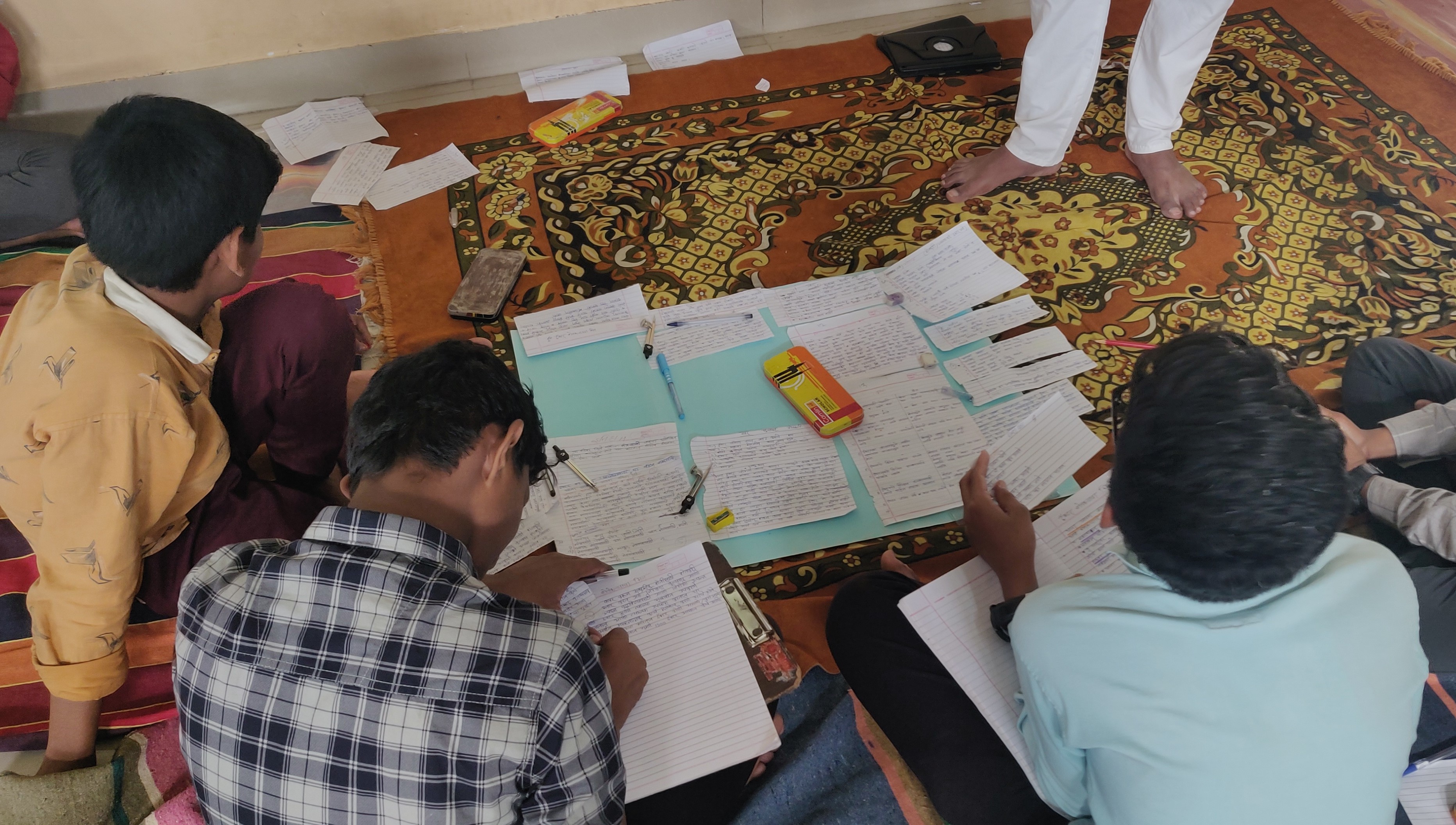
Physically moving pieces of written text to understand how they fit together for their group authored article. This is from one of the sessions with students at Harali in their Science Journalism project. The articles they wrote can be seen here.

Reminded me of the old days when we had post-it notes or actually cut out pieces of interview transcripts while conducting analysis without QDAS.