Dilli Diary

Pune-Delhi on Duranto

We decided to take the train back home to Delhi from Pune – Partly to reminisce about Parag’s Pune-Delhi travel as a student, and partly to fulfill my love for train journeys. I am glad we decided to take the Duranto, a superfast train that brought us to Nizamuddin in 20hrs.

Our first train journey in India after 12 yrs was memorable due to the landscape outside and the service provided. We had an unending supply of food, clean bedding, and very helpful servers. Here are some photos:
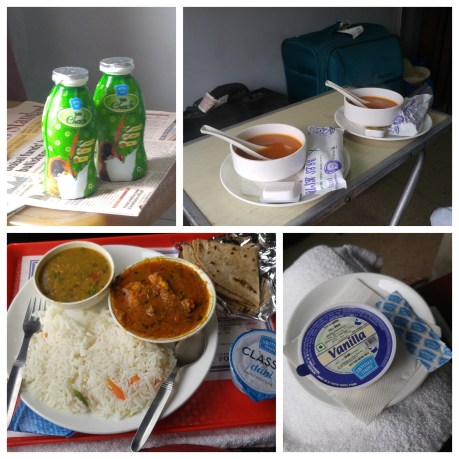
duranto food collage

The route was different than the other trains to Delhi that go through Daund. We took a North westerly route going via Khandala, skirting Mumbai, continuing on to Gujarat, and then Madhya Pradesh. It is end of June. The Monsoon has settled in making it the best time to enjoy the landscape through wide windows spanning the entire coupe.

IMG_5990

Khandala ghat area as always was full of waterfalls. Lush green undergrowth covering  all the rock faces everywhere.

After a patch of concrete jungle as we went past outskirts of Mumbai, it was mostly pastoral landscape. Some areas were tilled, ready for sowing, waiting for the right amount of rain, some drenched in rain ready probably for paddy. Some people were catching fresh water fish and probably crabs in shallow rivulettes and fields filled with water:

The 20 hr time was managed because there were only 5 stops. Vadodara was the longest at 16 minutes where we got a chance to get out, buy the famous gujarat peanuts, and watch the hustle and bustle:


Musings

IPC 497, 498: Am I still my husband’s property?

I was agitated watching a Marathi soap opera that depicted a scene where a couple living out of wedlock was told there would be legal consequances. The man was told he can face jail time for adultery. ‘What nonsense’ I said, ‘these people should not show such blatantly untrue things’. I have had such bouts of frustration watching medical details portrayed eroneously as well. It has detrimental effect on societal understanding of medical and legal facts.

Before I started writing a scathing critique I decided to check the penal code related to marriage. Lo and behold, the soap opera writers are more knowledgeable about legalities than I thought I was:

Section-497- Adultery “Whoever has sexual intercourse with a person who is and whom he knows or has reason to believe to be the wife of another man, without the consent or connivance of that man, such sexual intercourse not amounting to the offence of rape, is guilty of the offence of adultery, and shall be punished with imprisonment of either description for a term which may extend to five years, or with fine, or with both. In such case, the wife shall not be punishable as an abettor.”

Wow! how did I not know this? Note that it is about a man’s wife being ‘stolen’. It does not matter if a married man is stolen by another. I just assumed that we live in the 21st century and women are not considered a man’s possession anymore. I suddenly feel extremely uncomfortable being married under the marriage act in India. I wasn’t aware what I was signing up for.

The term adultery itself is a remnant of the patriarchical understanding of ‘Pavitrya’ (purity) of the woman that is necessary for the man to establish his genetic lineage. Woman’s womb being the ‘Kshetra’ (literally, the field) that needs to remain unadulterated and untouched by any other man.

Section-498- Enticing or taking away or detaining with criminal intent a married woman “Whoever takes or entices any woman who is and whom he knows or has reasons to believe to be the wife of any other man, from that man, or from any person having the care of her on behalf of that man, with intent that she may have illicit intercourse with any person or conceals or detains with that intent any such woman, shall be punished with imprisonment of either description for a term which may extend to two years, or with fine, or with both”.

Taking a woman from her husband or from a ‘person having the care of her’ – This reads as if women are children who need a guardian at all times. ‘Enticing’ similarly makes women sound like naive juvenile beings without any agency or understanding of their own sexuality.

A little bit of digging shows that the law is contested couple of times without much success. However, I haven’t seen any information about a sustained movement to change these archaic laws. Time to find a women’s rights group that is working on it and see how I can support it.


Musings

Language and National Identity

The language skirmishes keep errupting on twitter with #StopHindiImposition, #StopHindiImperialism, …. trending everytime somebody shares another incident of local languages or English being substituted with Hindi.

Most of the times the immediate response from Hindi speakers is that Hindi is the national language (which is quickly striken down as a falsehood), followed by claim that we need one language for the unity or existance of the country, English being the language of the colonizers is not acceptable, thus Hindi is the only option.

The fundamental question to be asked with respect to this discourse is do we need one language to form a nation state. Some may point to the European example of nation states, each with its own language. Billig in his book Banal Natinalism (1995) questions this basic assumption of the need of one language to base a nation on. “Nationalist in attempting to create a separate nation, often will create a language as a distinct language, although they might claim to be creating the nation on the basis of the language, as if the latter were an ancient ‘natural’ fact”

His assertion is followed by multiple examples from Europe where languages are labelled as a particular language as part of the formation of the nation state rather than  on clear cut linguistic demarcation. He rightly points out that spoken languages in practice most of the times were a continuam as we moved from point A to B rather than regions with language A ending at one point and language B starting in the adjucent village.   One of his example is about languages spoken on the French and Italian borders where same/similar language is considered dialect of French while across the border it is considered as dialect of Italian.

“a dialect is frequently a language which did not succeed politically.”

This reminds me of Kokani, Varadhi, and other forms of Marathi and the Kokani struggle to be acknowledged as a separate language.  Similarly Bhojpuri, Maithili, Braj and other languages that are considered dialects of Hindi and consumed by it creating the ‘Hindi Belt’ in the minds of all the ‘south Indians’ tweeting about #StopHindiImpostion.

Hindi similarly is pushed again and again as the National language from the seat of power. Keeping the pride alive in regional languages thus is not just about the language and culture but about not letting go of the political clout. Unity under the banner of one language thus is marginalization of everybody else not speaking that languge.

Reference:

Billig, Michael (1995). Banal Nationalism, SAGE

Dilli Diary

Delhi Unseen

Coming home late nights or getting out early morning, you see a completely different Delhi.
Tonight we saw this gentleman heating milk on the road outside his dairy. The milk will have to cool down in shallow rectangular trays which will take beyond midnight on a hot day like this. Then put the ‘khatai’ to make dahi / yogurt ready for tomorrow morning.

This slideshow requires JavaScript.

On a parallel road cooking commences early in the morning. At 6 am when we walk by we see men who man the ‘cool water’ carts get ready for the day with a hefty breakfast of Puri bhaji or rajma roti or chana roti.

Social Media, Technology & Education

Consent

“People have the right to expect that researchers will treat them as autonomous individuals, respecting their decisions about whether to take part in research and about what personal information they will or will not share with others.”
As I read this while completing my IRB refresher, my brain kept coming back to the phrase ‘autonomous individuals’. I thought of my angst about unregulated unabashed marketing messages on mobiles in India and how I am flabourgasted everytime somebody asks me for my mobile phone number as if it is an obvious piece of information that ‘needs’ to be shared. More so as nobody in my immediate circle in India seems to be flabourgasted.

I wonder if people do not consider themselves to be autonomous individuals who can have any opinion, a question, or a say in what information they would be comfortable sharing or what messages they will be OK receiving as a result of this. If one is told that this piece of information is mandatory to be shared, one has to share it. No questions asked. How did we become these people?

Musings

The NRI AAdhar Limbo

As AAdhar related discussions heat up in the press parallel to the case hearing in Supreme court, our woes become more existential: are we or are we not of here. sigh

Technically being NRIs for last 12 years we are not eligible to apply for AAdhar. In spite of the court decision that AAdhar should be voluntary for everything except government subsidies or schemes, the ground reality is that we cannot move an inch without it.

The first major impediment was getting mobile phones. Getting a sim card needs AAdhar number for verification. When we visited India previously, we borrowed sims from relatives for temporary use. Now that we are here for the long haul it is proving to be difficult. The sim is registered to a specific person. The number is then connected to a variety of services along the way making it the most important number in your daily life, sometimes more so than the AAdhar number. sigh. (More about mobile as identity number here). Aadhar being mandatory for buying a sim was touted as the Supreme court mandate since 2015. The recent AAdhar court proceedings have clarified that the court never mandated any such thing. AAdhar fiasco continues. sigh. Read about it here. So probably the next time we get a new sim we might be able to get it without Aadhar.

In spite of the supreme court rulling that AAdhar should not be mandatory, ground realities are quite different. AAdhar photocopy is one of the items on the list of mandatory paperwork for cooking gas connection. Cooking gas involves government subsidy thus the need for AAdhar. However, you can give up the subsidy voluntarily. There are posters all over the gas agency proding you to give up the claim on subsidy if you can afford it so that the funds can be used for more underserved families. Technically if you are not availing the subsidy you should not need the AAdhar card but that point is lost on the paper pushers in the agency.  The subsidy is deposited in your AAdhar linked bank account. Being an NRI on paper, technically we cannot have AAdhar or a resident bank account. The most generous offer then is to buy gas cylinders on the black market.

As per the residency rules we are still NRIs. For banking purposes we have NRI accounts that have limitations. For more useful and practical resident accounts we need AAdhar. There was a stay on mandatory linking of bank accounts and credit cards but the rule is not applicable for opening new bank accounts or credit cards. I fail to see the logic of this rulling. Once I give Aadhar number to open an account, the rulling about ‘linking AAdhar not mandatory’ is a moot point. The NRI limbo continues as we try to find solutions in other NRI banking accounts. Being Non Resident Indians we are expected to have a residential address outside India where all the paperwork and cards will be delivered. We do not have any such address. We do have a residential address in India but we cannot use that for NRI account neither can we open a new resident account with that address without AAdhar.

Now I understand perfectly the plight of Trishanku hanging between two worlds.

Dilli Diary · Musings

Food for thought: Vegetarian Delhi

I was perplexed when we encountered multiple situations where our search for a house bumped against the ‘vegetarians only’ requirement. Till then I thought of Delhiites as a staunchly meat eating people. When I thought of Delhi I always thought of it as a Muslim and Punjabi city with Mughlai and Punjabi food influence, in my mind heavily dependent on meat.

When house hunting, contrary to this belief, we found many more eateries serving purely vegetarian food, many times vegetarian versions of what I thought was predominantly meat dishes like chaap. Chaap as far as I understand is minced or cubed things cooked on skewers. The area we live in is full of chapp places selling paneer, soya, green jackfruit, and so on. I assumed it was a very specific thing about our neighbourhood.

Today the INTACH heritage walk however completely changed my understanding of delhi residents. We were supposed to meet near the Jain Temple in front of the Red fort. I was curious how a Jain temple ended up just outside the Red fort gate. It was astonishing to learn about the importance of Jain treasurers in the Mughal courts. The history books told us about the Rajput and maratha warriors in the court but I never heard the stories of other communities. Our walk through Chandani chawk and surroundings with multiple Jain temples, and havelis of Jain merchants further wiped out my mental map of delhi as a culturally/historically Muslim and Punjabi city.


Musings · Social Media, Technology & Education

You’ve got a message!

One thing I am still getting used to being back in India is the number of marketing messages I receive now that I have a local sim. This started immediately after I got the sim before providing my mobile number to numerous webapps, shops, govt agencies, and other everyday services.

Vodafone keeps sending messages about variety of phone and data packages. There are the massage parlour messages promising beautiful young girls as masseuse. Not sure how I got on their list. Probably remnants from the previous owner of the sim. Now after a couple months there are myriad other messages from shops and services where I had to give my phone number to start a transaction.

It is disturbing how casually mobile numbers are asked and provided in any and every transaction. It is also amazing that nobody seems to be complaining about the constant bombardment of marketing messages or the fact that there is no way to opt out. I wonder if this space is not regulated at all in India or people are just going by the ‘chalta hai’ attitude as in other situations.


Dilli Diary

Eating out: Good, bad, ugly

1. Good: Saving condiments
Was pleasantly surprised and was really proud to see a place to deposit unused condiment sachets in a fast food restaurant. Have seen it multiple times since then at variety of places.

2. Bad: Standardized boring food
I was told that Delhi is the best place for a foodie. I have been dissapointed so far. May be it is an information asymmetry problem.
Everywhere you go it is the same old stuff – dal makhani, paneer makhanwala or variation of it with meat and veggies with the same base. I am sure there are so many interesting local dishes so why dish out the same old? Other options are MacD, sandwitches, burgers, and other standardized ‘western’ food at exhorbitant prices. I know I can go to CP for different cuisines and old delhi for local food but I am perplexed by the lack of real food in our vicinity. I miss thali in Pune or for that matter weekend Buffet at Rasoi in Providence, RI. I can’t believe I ate well in USA than in the capital of India. sigh

3. Unbelievable: Saving energy at the cost of food
We realized last week that shops just switch off the power to the freezer every few hours to save electricity cost. Thought it was a particular shop but then started looking for it and it is rampant. As it gets warmer outside (read scortching hot) the dairy products seem to have really short life, Dahi is sour. I haven’t started buying frozen meat yet and most probably I will just forget about it. I worry about medicines that need refrigeration. How are we supposed to know if the medical shops do this too? Hope it is a local problem and not a regular practice everywhere.

Dilli Diary · Musings

International Kala Mela

Last week I started feeling frantic as the sun felt hot and unbearable mid day, a signal of the excruciating heat to come that will stop all excursions for 5 months. As I looked for city walks, fares, or food tours and such found two things that I decided fit the bill: International Kalaa Mela organized by Lalit Kala Akadami and the Hunar Haat, a fare organized by the ministry of minority affairs to give platform to minority artisans. More about Hunar Haat later.

20180216_174948

It was a fascinating experience, so many different materials, genres, techniques, and motivations. The most intersting conversation was with ….. Sen. I was commenting about the different techniques on display and how it might be educative to students and artists alike when she commented – Seeing all these techniques makes it difficult to find yours. You have to unlearn to find your voice. Unlearning is much more difficult than learning.’ That stopped me in my tracks in addition to her beautiful paintings capturing different moods of the sea. We had a long chat about capturing sea, my impressions of paintings about sea and sea related art while I lived in Providence-Boston area, and the reason why her blues pulled me in more than I had ever experienced before. I started looking at all the things I was seeing with a different eye after these conversation. Sometimes I complain that some of the classical vocalists favour gimmic over expression. I started seeing that in the paintings as well.

Couple other conversations with artists about how they decide to frame their piece was an education in itself. I wonder if these practicalities are formal part of an artist’s education or they aquire the sense over the years experimenting with colors, textures, shapes, and empty space.

Some experiences were wordless silent observation. Like this pair painting without any thought to the onlookers.