Lot to digest, for example – Choosing two girls from these specific circumstances and not others to contrast, especially since the struggle between tradition and modernity was a thread throughout. The visual of the girl sitting at the beach facing the Mumbai skyline juxtaposed with silhouettes of mountains and temple spires on the left shows this thread of presentation to come. As the documentary progressed, it was very interesting to see assumptions made about what is ‘modern’ when it comes to women in India. What is considered freeing, enabling and how it is shown as one or the other rather than a complex mix in both the paths these girls chose.
I want to go back and watch it again to see how certain views, values, visuals were highlighted or played down.
Category: India Outside India
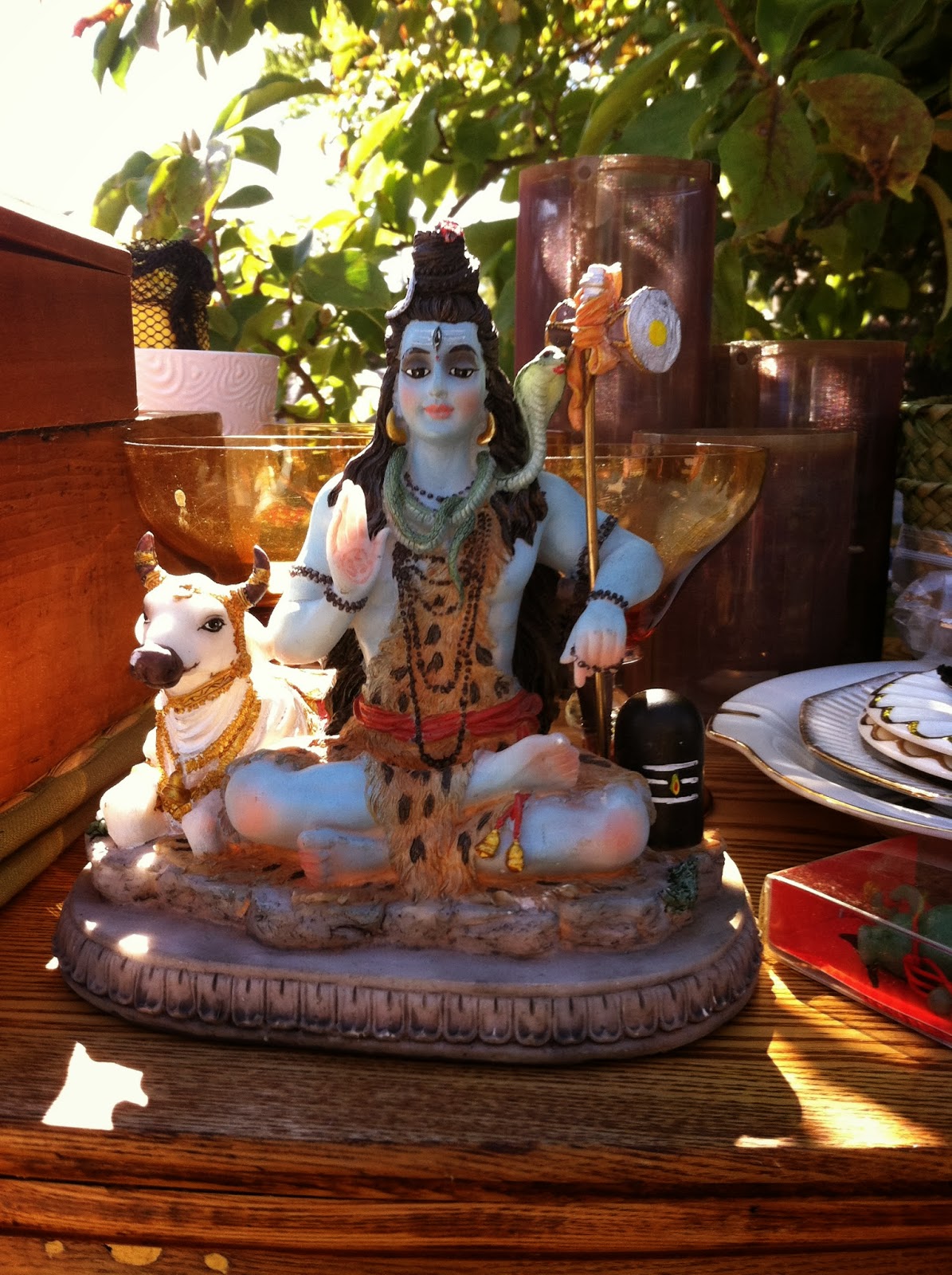
Collecting Deities
The lady manning the booth had various Ganesha idols, a bull that looked more like Nandi than the bull outside New York stock exchange. It seems her friend collected deities and these were some of her finds on a trip to India.
Siddis on the Indian Subcontinent
I have talked once in a while with my friends from South Africa about the people of African origin on the Indian subcontinent. I knew of them as Habashis who lived in Gujarat. I know that they came to India first as traders and seamen. However, I did not know anything about them beyond their existence. Habashis or the Abyssinians came to India from Ethiopia (Abyssinia). The exhibit mentions the port of Barygasa (modern day Bharuch, Gujarat) that was considered to be an Ethiopian town because of the east African traders who had settled there. So that is where my story of Africans in Gujarat came from I guess. I also knew of Siddis of Janjira but had not really thought of them as people from Africa.
The online exhibit put a lot of people and events I knew in perspective of the flow of people between different continents. This experience was similar to how things I already knew clicked in place when I was reading the book Sea of Poppies by Amitav Ghosh. I knew of the opium wars in China, the famines in Bengal, the British in Calcutta, history of Parsis in Bombay and so on but all of it clicked together in terms of actual people who moved between different places at that time and how happenings in one affected people in other far away places.
I could identify some of the historical happenings and names but did not know their African origin. For example, Ibn Batutta is a well known name for the record of his travels during 1300 A.D. in India, but I had not thought of his origins. He was a Moroccan. Malik Ambar, the formidable general during the Nizamshahi rule in the Deccan. I know of him but now I can place him in the overall migration, and movement of people from Ethiopia, to Arabia, to India as slaves, seamen, ivory traders. See the map of movement of people here.
The most surprising find was of the group of Habashi slaves from Goa when it was under Portuguese rule who ran away to Karanataka in free India. I had no awareness of these events. When we were growing up I heard stories of how my grandfather sneaked in and out of Goa during the Portuguese rule to see his relatives and friends and visit the temple of the family goddess. I never heard the story of the Habashis though. Now it is too late to ask him about them.
The online exhibition has a lot of images, paintings and photos – past and present that make this discovery interesting and more human than just reading the text.
The Schomburg Center also has an ongoing exhibition of images and artifacts open till July 6, 2013. Here is the information about it in case you are in NYC and are interested.
PS: Africa felt like a far away land when I was in India. I think I understand Africa (especially east Africa) differently now after coming to US in terms of where it is geographically in relation to the Indian subcontinent and how it is connected from land and sea. Conncections that I did not clearly see before. I wonder if physically being on another continent changes the way you look at the world geographically. Or does the awareness come from the multi-national crowd and subjects I am exposed to in New York City and in Teachers College.
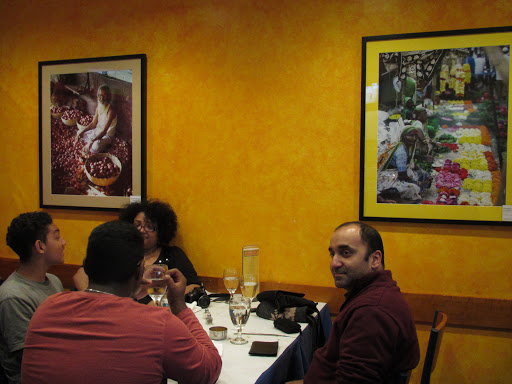
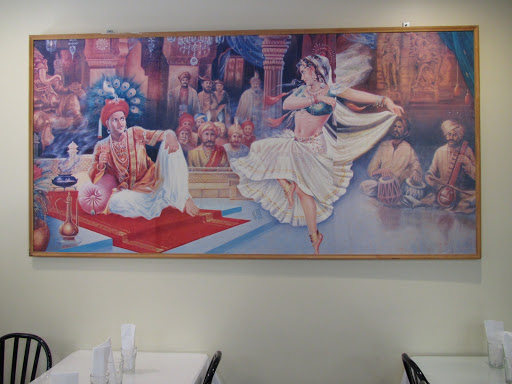
India portrayed in Indian restaurants
![]() |
![]() |
These photos reminded me of other surprising visuals used for decorations in other restaurants.
The following two paintings are from a restaurant in Niagara falls, US. The paintings portray the Peshvas based in Pune, one of the important players on the political scene locally in Maharashtra in 18th century and possibly on the subcontinent during the reign of Bajirav Peshva in the first half of the 18th century. The romantic story of Bajirav and Mastani the courtesan is well know in Maharashtra. The other painting was that of the Shanivarvada, the fortified palace of the Peshvas in Pune. You can see only a part of it behind me in the second photo. I was quite surprised to see the Peshvas as visual representation of Indian. Even in India, many of the people outside Maharashtra do not know of the Maratha and Peshva history as the history books focus more on the dynasties based in Delhi and the Rajputs of the North western region.
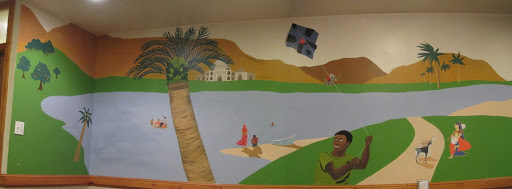
The other painting that caught my eye and made me chuckle is in another restaurant in Providence – Not Just Snacks. The painting has all the symbols of ‘exotic India’ bringing together different pieces of place and time in an unusual collage – elephant, peacock, Tajmahal, coconut, palm, and mango trees, a boy flying kite, a singer (Meerabai??) with a string instrument who is from some bygone era, and people who look like they are from northern India on the banks of a river (Ganga??) Oh and I forgot the deer mesmerized by the song Meerabai is playing/singing. Mountains behind the Tajmahal, the river plains in the middle and I am assuming desert behind Meerabai.
Swastika again …
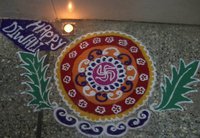
It was Diwali week last week. A lot of people from home updated their facebook profile photos with images related to their Diwali celebrations. One of it was of a rangoli in the doorway with swastika in the center. I was wondering what people outside of India (Western countries) will associate it with.Nothing much has changed after that. In the Diwali packet I got a sticker imitating Rangoli design. At both ends of the colorful strip are two swastikas. Rangoli designs are drawn for various reasons. The ones in the doorway like my sister sent, are to bring happiness, prosperity and feeling of festivity. The ausipicious symbol of a swastika, the name of which itself means ‘wellbeing’ is generally a given in such drawings. I obviously would not be putting it in my doorway in US for the fear that people will label me fascist, anti-Semite. I don’t know how I feel about this. I am not a big fan of Rangoli stickers (I rather draw whatever I feel like everyday) but the matter of am I free to draw or stick a swastika on my door (in the context of a rangoli) without being labeled anti-Semite still remains.
As I said nothing has changed.
Obama’s visit to India: Images perceived and portrayed
Some points that came up in the media coverage about perceived and redefined image of India
– Obama rejects view of India as “land of call centers”
– The United States sees Asia, especially India, as the market of the future
– India the land of cold-start (the Loch Ness monster that most of the Indians don’t know they have)
– India the victim of 2008 Mumbai attacks. (Just so that US can proclaim ‘India and US were united against terrorism’)
– On the other hand it is a giant ogling Pakistan on which US needs to put pressure so as to placate Pakistan and get its support in the ‘war against terrorism’
Diwali Message from Obama
Google Remembers Gandhi!
Chai tea, Masala chai and the real Indian tea
For the longest time I felt that it was my duty to educate Americans about the wrong nomenclature for the things they were eating under the name of Indian. Curry and Chai tea are two of my pet peeves. I have told numerous people numerous times (even when they didn’t care) that there is nothing called ‘curry’ in Indian cuisine, the way it is understood by Americans, Europeans and may be the rest of the world. I also started writing a blog post about it sometime back. I should publish it one of these days.
‘Chai tea’ was an irritation for two reasons – firstly, Chai tea is like saying ‘tea tea’. Chai means tea. It is hardly an adjective for tea. Secondly, I thought the spices they added in the name of Indian chai was just wrong. Just because we use spices like pepper, cinnamon, and cloves in Indian cuisine doesn’t mean we would add it in the spiced tea.
Cafe Fresh near Columbia serves a version of this ‘Chai tea’. The only relief is that the menu lists it as ‘Masala Chai’ (spiced tea). I was so excited to read the words ‘Masala Chai’ that I started frequenting the place for a cup of chai. Funnily, I have taken to the various versions of spiced tea sold by cafes like Starbucks and Cafe Fresh as well as those sold as teabags. Even though I like these spicy versions, I have always maintained that they are not real Indian tea because of the pepper in it.
So the other day when Shraddha and I were exchanging recipes and the secrets for the fresh home specific masalas, I was shocked to hear her version of the masala for chai. The masala in her house is made of Pepper, dried ginger powder and other spices. I asked her twice if that was her own recipe and she insisted that it was a traditional recipe. So all these years when I thought it was stupid of westerners to add pepper in the Chai, seems like they were more knowledgeable about some of the Indian customs than I was.
The tea bags with black or green tea and powdered or whole spices steeped in hot water still is nowhere close to the Masala chai made in any corner of India, but I have to regrettably take back my ill feelings about pepper in tea.
I still feel the need to introduce people to the chai (simple tea), and Masala chai we make at home. Tea powder/granules (not leaves) boiled till it is strong and dark. Fresh ginger and cardamom added while boiling for warmth on a rainy day. Generous milk added to soften the taste. A couple of my friends have got hooked to it. But I remember to add that it is my /our (Maharashtrian?? Puneri??) version of the tea, rather than extrapolating my experience as an average Indian experience.
Gandhi in NY: Peace, Social Activist, and World Leader
The first time I came across a mention of Mahatma Gandhi and a visual was in the sculpture garden of Cathedral of Saint John the Divine in the Fall of 2005. The sculptures were created by school children. I was actually pleasantly surprised. It (the surprised reaction) might have been because of the stereotype about Americans who have no general knowledge and no interest in the history, politics and happenings in the rest of the world. I try not to have such generalized notions of people. But this one is hard to get rid of. It also came from a feeling (at that time) of being culturally invisible. I was equally surprised for the same reason when I saw a picture of Indira Gandhi on a book cover about Women leaders in the classroom library of a Harlem school.
Anyway, continuing about Gandhi….I was so surprised that I decided to come back to take a photo, almost to prove to myself that ‘these people know about our Gandhi’. hahaha.
This photo of the sculpture was recently taken when I visited the sculpture garden again with my sister. (She was not suitably surprised to see Gandhi etched in a Cathedral garden. What a disappointment.) The sculpture is created by a school aged kid. It is a message of peace from Mahatma Gandhi.
In the same week we came across the sculpture of Mahatma Gandhi tucked away in a corner of Union square park. Wikipedia says that the newer addition of Gandhi’s sculpture in 1986 was to mark Union Square’s history of social activism.

The statue is quite well made. You can see the detail of his watch tucked in his Dhoti. Though I was quite disappointed to see him tucked in a corner like that.
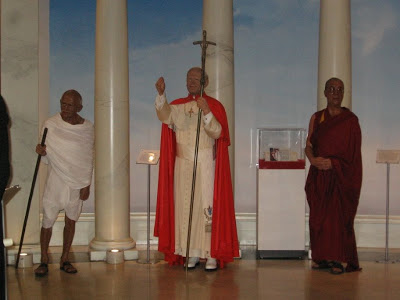
The following photo is from Madam Tussad’s on 42nd street. I thought the placement was very interesting – social leader, religious leader, spiritual leader.