India Outside India

Indian in US TV series

CSI – NY’s latest episode showed the festival of colors – holi being celebrated somewhere in Queens. I captured a couple of stills. As you can see the girls dancing are wearing a belly dancing costume. Is that a CSI version of Indian? CSI now-a-days is overly dramatizing scenes towards phony anyways.

Here is another one from the same scene. My first reaction was that this is another example of the ‘exotic east’ syndrome. But then again this might be the expression of Indian by the community in queens that I am discarding as not authentic enough. Me being the ‘real’ Indian and all. 😉

India Outside India · Musings

Swastika Part II

As mentioned in the previous post, I have been trying to spread the word offline and online. A few of those efforts were met with encouraging reactions from some american students. For example, a TC student was happy to receive information about the Indian Swastika and the way we use it in daily life. She also volunteered to talk about it with a friend in the student senate so that it can be handled at a macro level. I also wrote a comment on the public scribbling board made available during the unrest in TC in the main lobby.

I asked a question regarding spreading information about Swastika on Yahoo Answers. It received  mixed responce. Here is the link to the QA:
http://answers.yahoo.com/question/index;_ylt=Ate.S03nXLZHNxWLaKSoIxnsy6IX;_ylv=3?qid=20071109171936AAsU3xV

I will keep updating this post as and when I get more feedback

India Outside India · Musings

Indian Swastika and Hitler’s Hakenkreuz

(Imported from Musings)
The Swastika controversy is another issue that has been a huge part of my discussions, fact finding missions and such for the last couple of weeks. The controversy in my mind started with an image of a swastika in a brochure about hate crimes on campus and how to react to them. Unfortunately, the image of swastika they published was the straight faced Indian Swastika and not the tilted swastika of hitler showing 2 intelocked ‘S’. It was a photo of the sign painted on an African American House sign so judgimg by the reference it was definately meant as a hate symbol. My first reaction was to laugh at it ‘The haters didn’t even know which swastika showed hate’. But what about the creaters of the brochure? Did they think twice before choosing this image as an example of hate crime?
The brochure was a 10 point ‘to do’ list. The first point was ‘Rise Up’. A sentence in that section caught my attention “I didn’t mean to hurt doesn’t remove the hurt” “Rise up. The world won’t change if people don’t change it.”

So I decided to rethink my approach/reaction to the way the word ‘Swastika’ is used in U.S. As an Indian, swastika to me is a symbol of wellbeing. The word (originating from sanskrit Swasti) literally means that. Swastika is part of an Indian’s everyday life. When repeatedly swastika is mentioned as a hate symbol, how do Indian students react to it? I react by doing nothing or feeling nothing. The underlying thought process is ‘they are not aware of my swastika. They aren’t talking about the Indian swastika so I need not be offended.’ I talked to a few Indian students and they had a similar reaction. ‘we know better, just let it go.’

But is it right/fair to let go. Is it not offensive to hear repeated mentions of a symbol as a hate symbol when it is one of the most used auspicious symbols of a culture? Is it not unfair that an Indian cannot use his/her most auspicious symbol due to fear of being branded as fascist unnecesarily?

Some interesting stories came up when I was talking with the Indian students. The stories were about lack of information about the Indian (real??) swastika by westerners and the problems crreated by it. The stories were exchanged mostly as hilarious incidents. One of it goes like this: “An Indian student was coming to US to study. His father thought that it would be easier for him to find his bags if he had some kind of identifying sticker on it. The easiest available was the rangoli sticker used on the doorways which is very popular in Maharashtra. A rangoli sticker invaribly has a swastika in the center of the design. As I said before, swastika is a omnipresent symbol in India. He was arrested on one of the airports in Europe during the layover.” I shared this story with couple other Indian students. The discussion invariably focused on ‘how people who haven’t travelled outside India do not have a sense of such things’. Why is the burden of knowing and understanding on the shoulders of an Indian? Is it because we believe in ‘let go’?

What have we achieved by not reacting? Did we unknowingly support the abuse of the word/concept of ‘Swastika’ by not reacting? Will it make a difference if we educate people around us? Will it make a differnce if we protest against the use of the word ‘Swastika’ as a hate symbol and insist that the Nazi hate symbol be properly identified as ‘Hitler’s Swastika’ or ‘Hakenkreuz (hook-cross))’?

I am still debating in my mind about these questions. In the meanwhile I have also started talking about the issue with various american freinds offline and online. Resolving these questions for myself is going to take a long time. As they arn’t really about swastika but about changing philosophy of life in a new environment.

India Outside India

Pennies for Ganesha

Last year, I used to visit Metropolitan Museum frequently, on one such visit I thought I should see what they have from India and what they are saying about Indian art. I was pretty disappointed to see the meager collection. But something really interesting caught my eye. The Ganesha idol had pennies placed in front of it as if it was an idol in a temple. I did not have a camera at that time but I promised myself that I would come back to capture this sight. So here it is:

I still cannot imagine who will keep the pennies there and why. Was it strong belief or just desperate attempt to appease. Or may be it was simply an effort of the museum staff to create ambiance. LOL 😉

India Outside India

In the Zoo

We finally went to see the Bronx Zoo. I was pretty impressed with the design of the zoo. Each animal had a spacious area cordoned off by chainlink fense. The tiger also had a viewing area which was made of glass. The viewing area also gave information about the Tiger, its habitat and the Tiger projects all over the world. We reached there at the feeding time and could see their caretakers feeding them and later playing with them.


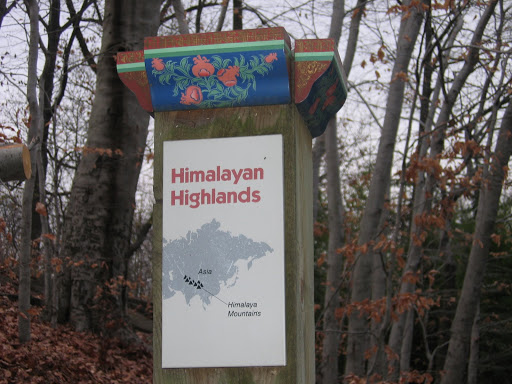
The vast area was divided into continents and then in types of habitats. The markers were designed so that they created an ambiance of being in that area.

See these two images for the Himalayan region.

I was impressed to look at the peacocks roaming around without fear. Reminded me of Jaipur.

India Outside India

Selling Indian

In summer NY comes alive with street bands, block fairs and fun things happening everywhere. The following 3 photos are taken in such fairs. Indian seems to be the buzzword in the fashion industry here at present. Not just in NY but down south as well. When I visited Charlotte, NC The Old Navy outlet there had a lot of merchandise with Indian fabric, designs and cuts in the ‘new trends’ section. The Chappals and sandals like those you would get in the Kolhapuri chappal stores were everywhere in NY as well as Charlotte.

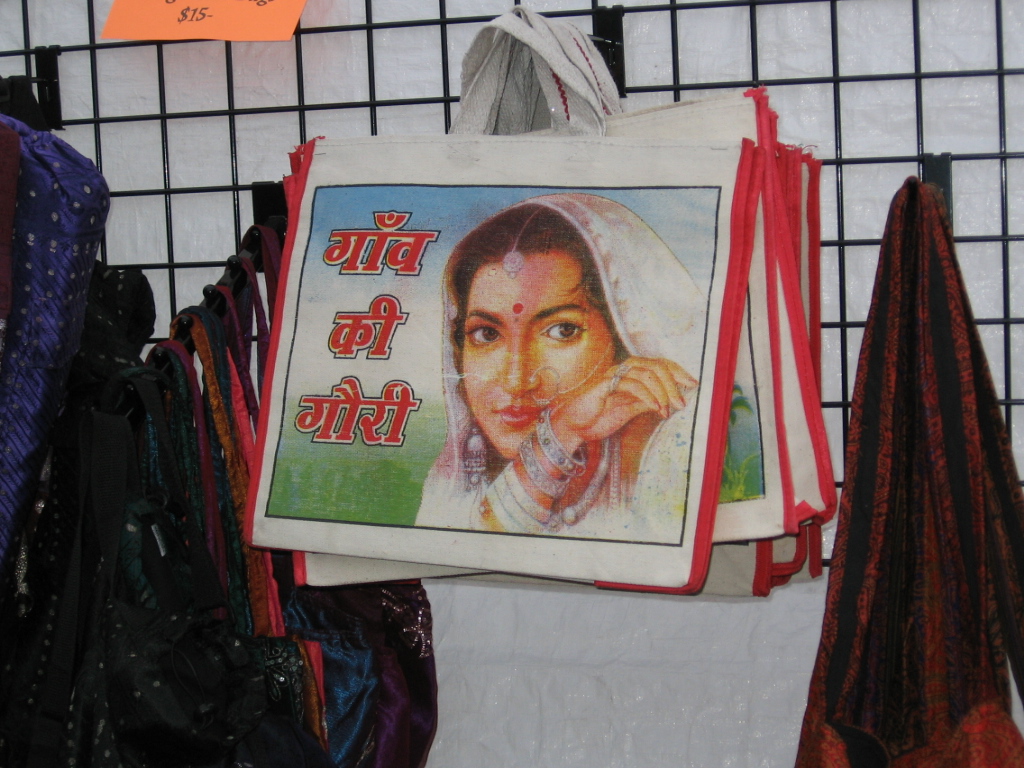
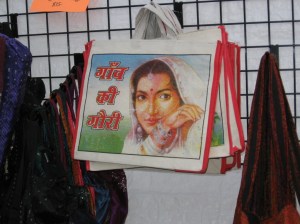
This photo is from a stall of a British lady. I have seen her in most of the fairs in and around Upper West side and midtown. I found the ‘Gaon ki Gauri’ handbag in her stall quite hilarious. She was selling it at a premium price cashing in on NewYorkers’ ‘exotic east’ syndrome. She took offence when I clicked a photo as if it was her patented design. lol :). I think I should have asked royalty on behalf of all the Gaon Ki Gori’s and all the Bollywood movies featuring them.
This lady also sells curtains which are actually saris cut in two with holders for a curtain hanger. Should have captured that too. That was also a hilarious site, Belgaum polyester, cotton-silk and other colorful saris with plastic Zari, hanging there on the road, being sold for a bomb. They were quite a lovely site I must admit and were attracting a lot of NY Goris. Seems like I am not the only weirdo who wanted to make curtains out of a Dharwad sari with Karnataki Kashida.

The other two photos are of stalls from Kashmiri guys selling Kaalin and clothing which can be best termed as fusion.
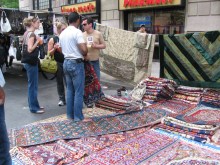
You don’t need to go to a fashion designing school to know how to cash in on a trend.

India Outside India

The Red Dot

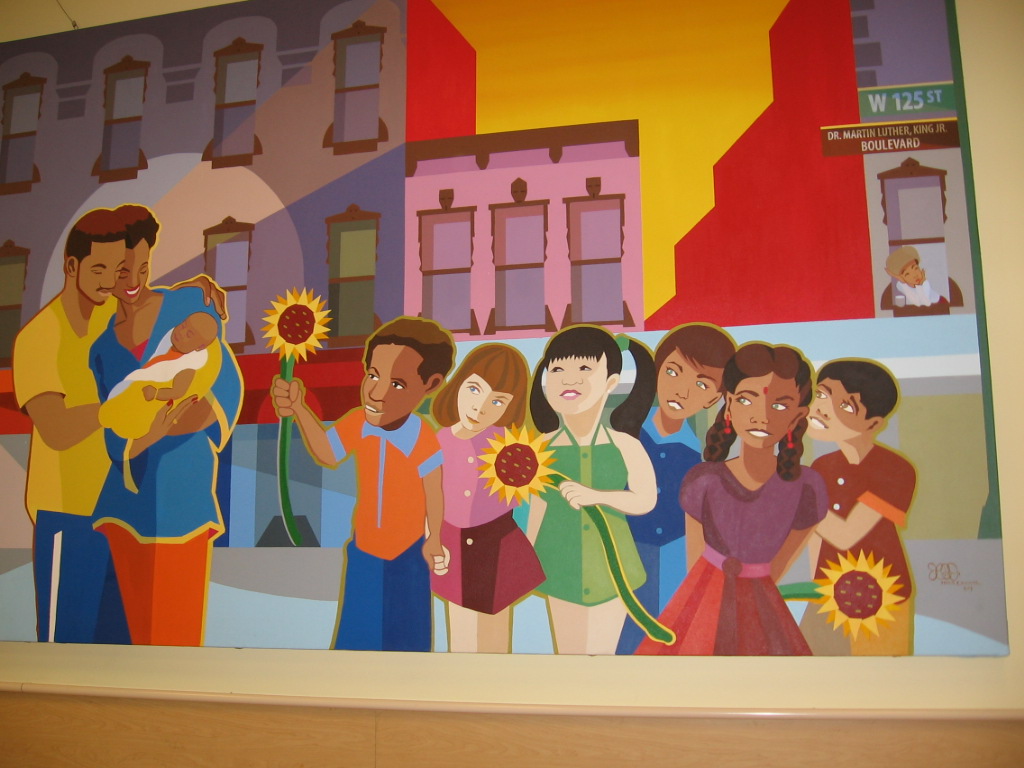
This is a painting in the lobby of Marshals on 125th street. Seems like they have tried to portray children of different ethnicity. The Indian girl is immediately noticeable with her Bindi and the hairstyle. The effect of the typical frock, hair braiding, bindi and the earrings is so amazing that I could see many of my school friends in that image.

Will try to find more about the artist and the motivation and share it on this blog.

India Outside India

Why ‘India Outside India’?

Since I came to US I have been trying to capture for the benefit of my international friends what is ‘India’ or ‘Indianness’. It is not an easy task, that everybody will agree. We have time and again discussed various facets of Indian people, culture, ways of meaning making and what it means to live as an Indian. It was also interesting when my international friends shared what they thought being Indian was/must be like for me.

I have been capturing visuals (mostly in form of photos) that I thought express non-Indians’ perceptions about India and also the expressions/visuals shared by the Indian community in US that must be shaping this perception. After a year of gathering images and talking in my head about it I thought why not put it all down in a blog.