Dilli Diary

People: Heralding Spring

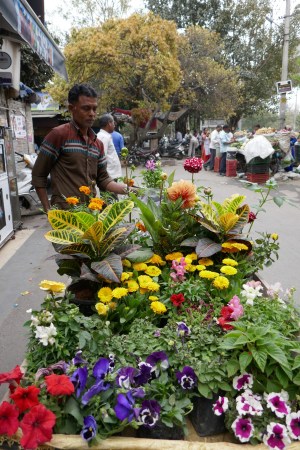
FoolwalaGetting down from the Model Town station I spied the herald of Spring. I picked up my pace before he could get back on his cycle rikshaw and disappeared.

As I started bargaining half heartedly, Hari, talked lovingly about his plants highlighting each one’s speciality that made it worth the money. He brings plants from Najafgarh and peddles them regularly in the Model Town area.

“I didn’t want to play the game to quote more and then say take it for less. I am selling it at a price that sells. The festival is almost here. I want to earn some money and go home.” he said, referring to Holi, the festival of color in North India. His home is a village near Kanpur he shared, with a longing smile.

Thanks for bringing these colors to my garden before Holi. Wish your’s is colorful too!

Dilli Diary

People: The Marvel

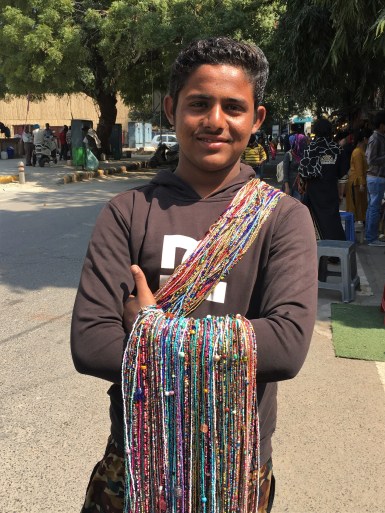
Last weekend we were in a mood to walk and explore the city. Ended up in this lane we were told is Gujarathi lane in Janpath market. Among all the road side stalls full of colorful embroidered wears and mirrorwork, this guy caught my attention. I can’t  not buy beads. Just one look and I start dreaming of all the earrings I can make.

Sagar_cropped

Sagar sells beads in this area regularly. However, today was a chance meet because generally, Saturday is his day off. He was hawking that day to get enough money to go watch the Captain Marvel movie. He has seen all Marvel movies there. He hasn’t read any Marvel comics though. He can’t read. Never been to school. “I learn as much about the story before I go”, he adds cheerfully. He was in a hurry to earn his 100 bucks. The show was in an hour so we moved on, but not before a quick photo and of course some beads for me.

Musings

Election fever

Today I started my day with page after page of goverment advertisements rather than fresh from the press daily news. First three pages of Hindustan Times today have advertisements from Odisha govt (Naveen Patnaik featured), Ministry of Rural Development (Narendra Modi featured), Ministry of Renewable Energy (Narendra Modi featured).

The inside pages have seven full page ads – six featuring modi (two of those with Yogi Adityanath), one featuring Kejriwal. Add to that four half/quarter page ads featuring modi (one of it with Yogi Adityanath).

In all this noise, I forgot it was women’s day. That explains the ads by Delhi Police focusing on women’s safety. Thankfully with images of women rather than some politician or administrator. Now I go through all the ads featuring politicians and realize, one full page ad with Kejriwal is wishing ‘Happy Women’s Day’ and listing the events organized by his govt. Another quarter page ad with Modi and Yogi Adityanath congratulating Uttar Pradesh’s achievements to respect women’s power.

Out of all these, the Odisha govt advert is the most straightforward with the tag line – “Everyone Makes Promises, Did we fulfill our promisses made in 2014?” The rest of the page has the report card and links for further information. At least it is clearly saying it is election related.

I wonder how much money is spent on this publicity. Who pays the bill? Is there an upper limit or guidelines so that the party in power does not have undue advantage? The ads with politicians in power prominently plastered on them, have been flooding newspapers for a while now. At least the ones we read regularly – Hindustan Times and Hindu. Many of these have Modi, some Kejriwal, one off here and there from Himachal, Haryana, and today Odisha. I wonder who is the audience. Do newspapers have different editions in different areas? From my own experience, I have not learnt anything about the Yojanas they are advertising. The only thing I remember seeing is Modi, Yogi Adiyanath, Kejriwal.

Musings

It’s a way of life

I remember clearly when I heard the aphorism “hinduism is not a religion, it is a way of life”. I worked in India at that time and was visiting Chicago to meet a client. I am not sure how the conversation veered towards religion. Probably, from vegetarianism or beef on the menu and my client wondering if I was a Hindu and offended. I must have stopped for a second with my mouth almost forming an answer, considering all the nuances of born as, being or not being a Hindu and how to express it in a succinct yet not misleading way. And she helpfully offered “it is a way of life”.

Since then I have been hearing it increasingly regularly. Might be because I lived in USA for the longest time after that in metros where ‘woke’ people ‘know’ these things. I am not sure how and where this idea came up. Probably, to explain that hinduism is not like other abrahmic religions – structured, built around a holy book, and practiced as a congregation. It is a motley collection of people and practices.

I was surprised when I heard it again during a heritage walk of old Delhi. The walk facilitator was talking about how the category Hindu, referring to religion, came up as a catch all phrase for non-moslem and non-christian/european people during the British times and then took root in the social psyche and census data. Someone chimed in helpfully, “yeah, I have heard, hinduism is a way of life”.

The first time I heard that term and internalized it, I thought it was helpful. To me ‘a way of life’ signified varied ways of life, not one specific god, no particular religious book that is termed the holy book like bible, no singular religious practice that can label a person as practicing or non-practicing Hindu. It acknowledged the many formal, named darshanas (philosophical schools) and many practices not codified.

Lately, I have realized that the aphorism doesn’t really mean anything. If you asked various people labelled hindus, what are the highlights of the ‘way of life’, it would be very difficult to come up with a list that everybody agrees with. Even if we come up with a theoretical list of attributes (vegetarianism being the most touted), I am pretty sure it would not match the actual lived experiences of people. So, whose way of life are we claiming is hinduism? The term is just an easy way to sidestep all the difficult conversations and realization that there is no homogeneous mass that can be termed hindu.
Dilli Diary

Many moods of Lodhi Garden

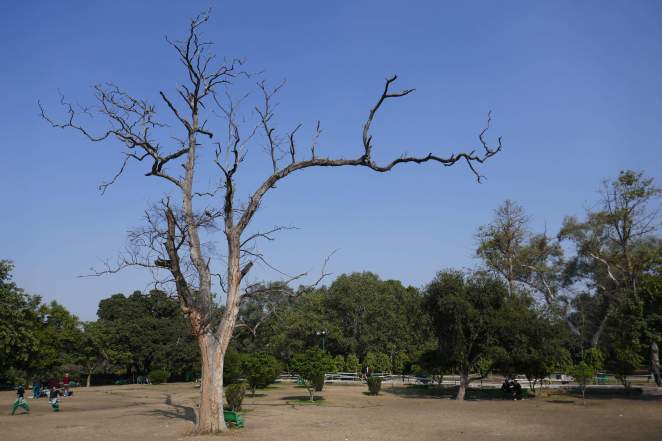
I had heard of Lodhi Garden and imagined it to be a mughal garden or a place with sprawling lawns. A morning walk with INTACH surprised me with the various corners of the garden that had a completely different feel with some woodland, a rosegarden, bamboo thickets, and playgrounds. A day spent sunning in various parts showed me how it can be different things for different people.

The monuments are mostly tombs from the Lodhi period except one, that gives it the name Lodhi Garden. I was surprised to see the stunning plaster work in some. Not so surprised with the disfiguring, hearts and names drawn or etched in the walls.

The heritage walk focused on the tombs in the garden, their history and artchitecture. We were hurried from one monument to another so that we could spend more time on the structures. I decided to go back in, after the walk and take a leisurely stroll. The park around noon was full of school children. I thought it might be the lunch break for a school near by. Learned later that they were on a day long tour of Delhi. Lodhi Garden being the best part. They were enthusiastically trying out the fitness equipment, playing tag on the lawn, climbing and jumping from one of the tombs from the side that did not have steps, some quietly sitting under a tree or a bush eating the packed lunch they brought from home.

This slideshow requires JavaScript.

The sky was a beautiful blue. Very rare in Delhi.

P1030831.jpg

Slowly, office goers started coming in to enjoy their lunch break and to thaw in the sun. It seemed like each group had their own area where they like to sit everyday. Some people stretched out on the lawn to take a nap. Then it was time for the senior citizens in walking shoes ready to take on their daily exercise schedule.

I took advantage of the sunny day and decided to find a bench and work in the open instead of going to Khan market in search of a cafe where I was planning to work. It was for the most part a fantastic experience except once when a gust of wind kicked up a lot of dust and I had to scramble to close and protect my laptop. By this time I had explored half of the garden and worked a couple of hours. Now it was time to resume my original plan to walk northwards to exit the garden towards Khan market. I was delayed by the water body that is home to a lot of interesting birds. You can stand on the bridge and watch them feeding for hours.

This slideshow requires JavaScript.


Musings

The breakdown continues

The National Statistical Commission (NSC) is now defunct after the remaining two non-official/independent members (read: not political stooges) resigned on Monday. The reason cited was that the commission was not being taken seriously by the government. Their suggestions ignored; the reports they vetted were not published etc. There was also the controversy of tweaking the  economic growth data. The NSC was established in 2006 “with a mandate to evolve policies, priorities and standards in statistical matters.”

Massaging of data for political gains has lasting effects. It is impossible to gauge where we are and where we are going if we cannot depend on the consistancy of data collection instruments and methods of calculating key variables. Whoever comes to power next, the damage is already done and is irreversible. Now with NSC a non-functioning body there is no one to raise alarm or vett methods. In addition to all the fake news and emotional arguments, now we have data coming out of government agencies that is untrustworthy created by people with zero data ethics or academic scruple.

References:

  • Asit Ranjan Mishra. Two Members of National Statistical Commission Resign, Mint, January 30, 2019.
  • Govt sits on post-noteban jobs report, two top statistics panel members quit, NDTV??,  January 30, 2019.
Musings

Amchi Marathi

Last weekend we attended the Triratna Mahotsava a three day festival honouring the three Marathi artists – Sudhir Phadake, Madgulkar, and P. L. Deshpande, in their centenary year. This is the second major event organized by Dilli Marathi Pratishthan. I am amazed at the level of organizing and greatful for the apportunity to attend the programs free of cost.

A few references however were instructive of who were assumed to be the ‘Marathi’ people in audience. A few conversations revealed how the others were painfully aware of it.

अत्रे, पु. ल. यांच्या  लेखनावर पोसलेली पिढी was something that really drove home the ब्राह्मणी बाज of the presentation. A snarky comment about how people speak in Marathi now-a-days – मी आली मी गेली or मला कागद भेटला नाही instead of मिळाला नाही. The examples showed how clueless presenters were about language use outside their circle.

Praman Bhasha or standard Marathi. Who decides the standard? For Marathi the Puneri brahmani marathi has been the standard. Other linguistic practices are considered to be dialects or ill spoken, गावठी, not pure.

During the tea break, a couple sharing our table was talking about the jokes related to ‘marathi nowadays’. The wife said his Marathi is mixed with Hindi as he is from the borderland. The husband said, “no, that is how we speak Marathi. It is not a hodgepodge of marathi and hindi I am speaking.”

My comment that it was a very puneri, kokanastha brahman kind of snark and is insulting, was overheard by a गोरे घारे पुणेरी uncle. “you really feel that?”, he said perplexed. I remembered my mother once told me the story of how it was mindboggling when she realised that nobody other than her knew about PL in her class of Mphil, A cohort of people from different states in an institution in Pune. PL, a writer she thought was world renowned. And she realised how small her world was. I hope the gentleman thought on the same lines rather than taking it as a personal attack.

Musings

Down the memory lane

My mother has been after me to look at all the books, papers, and random nicknacks we (sisters) left at her place at various times. It finally came to a head. I was in one of those particular moods when I can effortlessly give up on sentimental things of no practical use and my mother was on a war path towards a clutter free home. Although in one of our moods, we spent a bit of time lingering on some finds and reminiscing about life from my KG days to my wedding.

I was amazed to look at the 2nd grade Diwali homework book. My mother made arithmatic fun by making me create garlands of dried seed pods matching the numbers. The notebook still has the garlands. The writing exercises had cutouts from magazines beautifying the practice text. The cover was also beautified with diwali images and drawing around it.

I have heard stories of my dramatized recitions of poems. My aunts, uncles and older cousins still remember it and there is a black and white photo in one of the albums. Two of the famous ones were ‘Kilbil kilbil Pakshi Bolati’ किलबिल किलबिल पक्षी बोलती – a poem about a dream and another one ‘Asa kasa asata ho motthyancha Vaagana’ अस कस असत हो मोठ्याच वागण? – a light hearted poem complaining about hypocracy of adults. Found the later in a newspaper cutting from Nov 28, 1976 with some others my mother had saved. One of the poems has ba ba blacksheep scribbled in devanagari script. I wonder if she was deciding between the English nursery rhymes and these quirky Marathi unknown gems. I am glad she decided to go with the ‘quirky Marathi’.

Another diary had meticulously saved, attached and labelled feathers. I remember this from a school project with Gauri somewhere around 8th or 9th grade. We used to go to Sarasbaug early in the morning to collect the feathers. I forget what the project was (probably something about learning from the birds about aerodynamics) but I am amazed at the collection. p1030767

Utterly mindboggling find was a math question paper from 1951 from a school in Belgaum. We had a fun time trying to figure out whose it might be. It was way before any of my parents or uncles would have been in school let alone my cousins. We decided my grandfather must have repurposed it to wrap a bundle or a book and somehow it got displaced as we were moving things around.

p1030766.jpg

This letter from my grandfather (mother’s father) to my father after meeting Parag for the first time made me emotional. It has been   years. Plenty of water under the bridge. None of my grandparents are alive anymore. Parag is now a part of the extended Deshpande family but these first words of acceptance and trust in me still makes me feel their strong supporting presence.

Musings

Election time

There has been quite a stir after the state elections of Telangana, Madhya Pradesh, and Rajasthan. BJP suffered heavy losses making people wonder how they will fare in the Loksabha elections coming up in 2019. We will be voting after a long absense in the country, so I am watching how things are unfolding.

What I think is more important than the BJP defeat is the revival and increasing importance of regional parties rather than the national parties. In Telangana the Telangana Rashtra Samiti (TRS) won 88 of the 119 seats. His political ambition seems to be forming a front of regional parties to contest Loksabha election. Mizoram elections from Novemebr 26 did not cause as much stir as the BJP being ousted from the ‘Hindi belt’ states (Chhattishbargh, Madhya Pradesh, Rajasthan) in the recent one. [I abhore the term Hindi belt, but more on that later].  Mizo National Front (MNF) won 28 of the 40 seats in Mizoram, in comparison to 5 for Congress and 1 for BJP.  In Rajasthan, the news of course is the ousting of BJP, but if we look at the other contenders, Beniwal’s  Rashtriya Lokatantrik Party (RLP), floated a month before the election after breaking away from BJP won 3 seats. They also got sizable votes in some districts they did not win, which ended up deciding the winner between Congress and BJP.

There is the caste, religion angle to all these, but I think the most impportant is that they are regional parties. Some think that a strong national party at the center is better for things to get done. Many vote differently in state elections vs Loksabha elections because of this. So, it might turn out to be the same old in 2019 with respect to the central government. The logic is that conglomeration of regional parties in power is unstable and moves slowly as it spends/wastes much more time to keep the motley crew together.  I think the time is well spent though. I prefer moving slowly, acknowledging the regional diversity in terms of people, practices, needs, motivations, what they value – what development means to each, rather than a national party that paints everybody and everything in broad strokes creating power pockets for some regions ignoring most others.

PS: When Parag read this post he pointed out his research: A political economy of sub-national government spending in India. The point to be highlighted here is: “Politically less cohesive governements spend more on education and less on agriculture than there more cohesive counterparts.” Agricultural expenditure here is revenue expenditure related to votebank creation compared to education which is a developmental expenditure having long term effects.

Musings

The Hindi Belt

All the newspapers today including the e-news I read highlighted BJP’s loss in the ‘hindi belt’ or the ‘hindi heartland’. The election results were from Rajasthan, Chhattisgarh, and Madhya Pradesh.

These three states are not a cohesive, monolith as the nomenclature ‘hindi belt’ suggests. Chhattisgarh was created by separating 10 Chhattisgarhi speaking districts and 6 Gondi speaking districts from Madhya Pradesh. Rajasthan in itself is a culturally and liguistically diverse state. Definitely not a Hindi monolith.

When we visited Bharatpur, we realized the local language of the area is Braj shared with the Mathura, Agra region in Uttar Pradesh. On the west the Marwar region’s main language is Marwari. Marwari including other languages such as Harauti, Dhundhari, Mewari, Shekhawati, Bagri etc. spoken in the state are mostly referred to as Rajasthani dialects. To add to insult, all these languages are lumped under the Hindi umbrella in the census. In Madhya Pradesh, even after the separation of Chhattisgarh, there are still Malvi, Nimadi, Bundeli. These again are considered by some as dialects of Hindi.

The interesting part about defining languages and dialect is that it is not a science. It mostly comes down to power and geopolitical history. Due to quirks of the census more and more people are pushed under the Hindi umbrella. It doesn’t help that the language of the state government in these states is Hindi. That makes Hindi the coveted language and other native tongues in some people’s mind a sign of backward unsofistication. It is high time we acknowledge and celebrate the diversity in the northern region instead of painting it in broad strokes.