This year again I was in Harali, working with Anandshala facilitators, when the editorial work for the Technology in Education issue of the IAFOR Journal of Education was at its peak. This year, similar to last year we had a lot of papers on AI. Some of them got through the peer review process and are published in the latest issue.
As we review various papers on AI, the discourse focuses on subjects such as evaluation challenges as AI becomes ubiquitous etc. as well as unexpected topics such as AI assisted plush toys/robots for children with autism. Here at Harali, I see student circumstances many generations behind this fast moving world. The cognitive dissonance is jarring.
Juggling the two drastically different contexts I inhabit, one with cutting edge technology and other with nomadic community in a disadvantaged district made me think of the socio-political context of educational technology. The editorial introduction this year focused on the ‘critical turn’ in educational technology is inspired by this experience.
When talking about medium of instruction NEP2020 mentions mothertongue in conjunction with other languages – “home language/mother tongue/local language/regional language”. Mothertongue is thus casually equated to the regional language when it comes to classroom practice. This discourse many times skirts the usage of minority languages, giving primacy to named local or regional languages.
An interesting dialogue with a student at Harali shows how the confusion or ‘taking for granted’ is not just in the policy but has also entered the discourse on the ground: तुझी मातृभाषा काय? [What is your mothertongue?] मराठी [Marathi] आईशी कुठल्या भाषेत बोलतोस? [In which language do you speak with your mother] बनजारी [Banjari]
Working with the Laman Banjara children in Anandshala, we have been exploring various facets of the problem आपली मुलं शाळेत फुलत का नाहीत? [why don’t our children prosper in school]. A couple of years back we talked with the parents, children, and the teachers about language transition from home language to school language – their experiences, what they think works and does not work.
As educators, learning scientists, linguistic anthropologits, we think that it is important to support the home language. Use it in verbal exchange in formal and informal learning spaces; create learning material in the home language; encourage translanguaging. While parents want their children to quickly move on to Marathi and English. When asked “don’t you worry you will lose your language?” The answer was – “We talk in our language at home. It will not disappear. But the children need to learn English to get a job in the office and change their plight.”
An article on Kolami speaking community in PARI reminded me of this exchange. Kolami is named as an endangered language by UNESCO. But the speakers have more pressing issues than saving their language:
“There is no time to think about anything else [other than her farm],” she says about the status of Kolami as an endangered language. When Sunita and her community didn’t know fluent Marathi, “everyone would say ‘speak in Marathi! speak in Marathi!’” And now when the language is endangered, “everyone wants us to speak in Kolami,” she chuckles. “We speak our language. Our children too,” she asserts. “It’s only when we go out that we speak in Marathi. When we come back home, we speak our language.” “ Aapli bhasha aaplich rahili pahije [Our language should remain ours]. Kolami should be Kolami and Marathi should be Marathi. That is what matters.”
It is the exact same discourse. When there is urgent need of improving dire living situation, saving home language or the identity formation of the child in the first five school years based on home language, and all the theories of learning are not a priority.
Working with the community as a participatory practice rather than an intervention, where do we stand when our beliefs about primacy of home language butt against the basic struggle to stay alive?
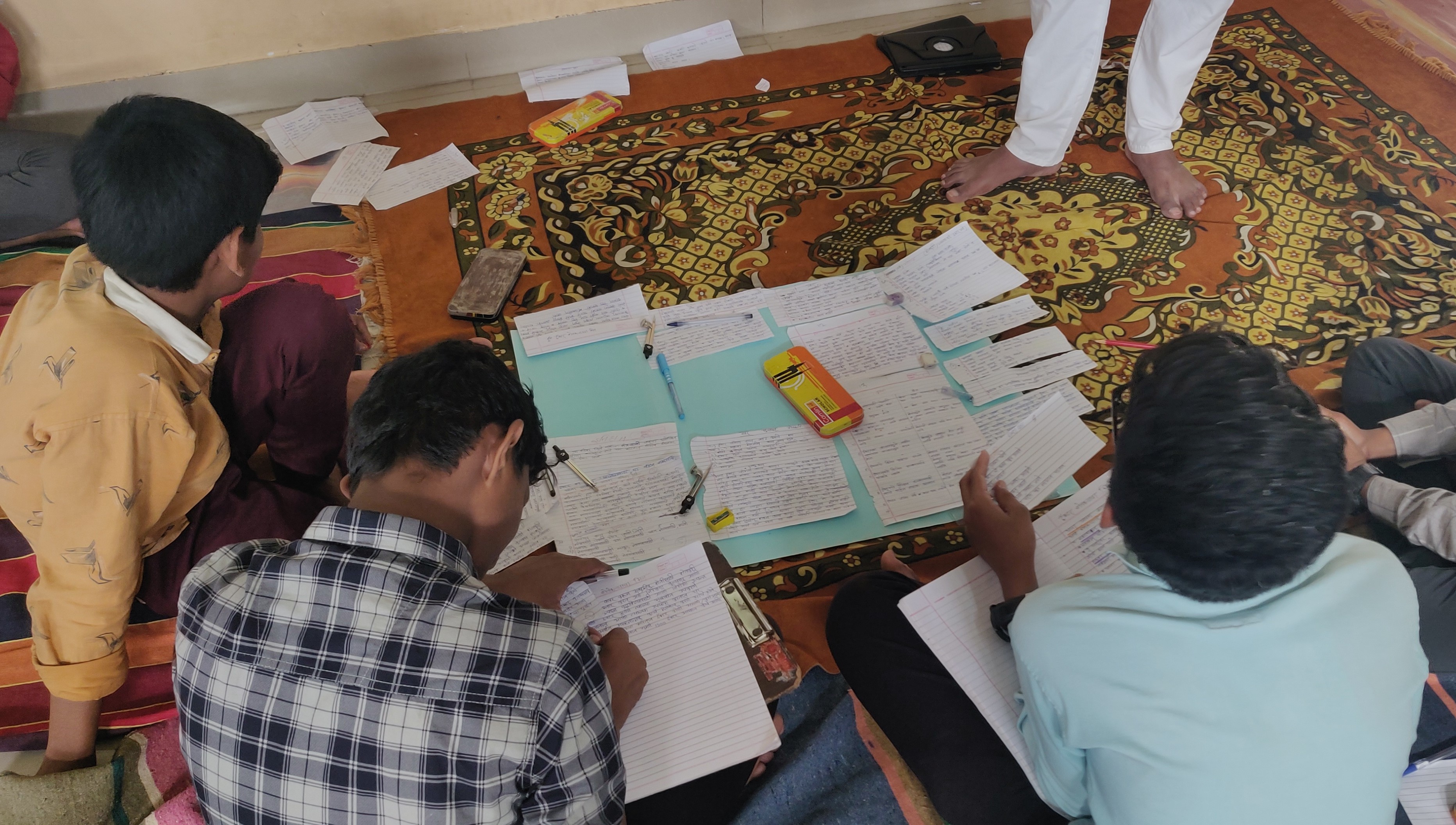
Physically moving pieces of written text to understand how they fit together for their group authored article. This is from one of the sessions with students at Harali in their Science Journalism project. The articles they wrote can be seen here.
Reminded me of the old days when we had post-it notes or actually cut out pieces of interview transcripts while conducting analysis without QDAS.
खेळ आणि मित्र मैत्रिणीं बरोबर शिकायचं म्हणजे नक्की काय याचं एक छान उदाहरण सेवालाल नगरच्या आनंदशाळेत गेलेले असताना दिसलं. एका तासाला विकासदादानी सर्व मुलांना दोन गटात विभागलं. एका गटानी गणित घालायच आणि ते दुसऱ्या गटानी वहीत न लिहिता मनात सोडवून उत्तर द्यायचं. पहिल्या गटानी उत्तर बरोबर आहे का हे सांगायचं असे खेळाचे नियम ठरले. जोरदार स्पर्धा सुरू झाली. वेगानी आकडे येऊ लागले. काही मुलांना विचार करायला वेळच मिळेना मग विकासदादा मध्ये पडले आणि उत्तर न देणाऱ्या मुलांना वेळ आणि संधि मिळेल असं पाहू लागले.
एका मुलीनी मग उत्साहानी गणित घातलं. दादानी मागे बसलेल्या एका मुलाला उत्तर सांगायला सांगितलं. उत्तर बरोबर आहे का हे मुलीला सांगता येईना. गणित घालायच्या उत्साहात ती ते सोडवायचं विसरली होती. इतर मुली तिच्या मदतीला आल्या आणि उत्तर बरोबर आहे असं सांगितलं. आणखीन एका राऊंड मध्ये पहिल्या गटातल्या एका मुलानी सांगितलेलं उत्तर दूसऱ्या गटानी चूक आहे म्हटलं. मुलानी पुनः सोडवून पाहिल आणि तेच उत्तर दिलं. पुन्हा गट अडून बसला उत्तर चुकलं म्हणून. दादा शांतपणे उत्तर न सांगता, मुलं काय करतात ते पहात होते. शेवटी वहीत करून पहा अस दुसऱ्या गटानी सुचवलं. वहीत मांडल्यावर त्याला त्याची चूक लक्षात आली. खेळ पुढे सरकला.
खेळा मुळे संचारलेल्या उत्साहामुळे मागे बसणारी आणि मागे राहणारी मुले सुद्धा हिरीरीने भाग घेऊ लागली. गणित आपणही घालू शकतो, चूक-बरोबर आपणही ठरवू शकतो ह्या नव्या अनुभवामुळे सर्वच मुलांचा आनंद, उत्साह, आणि प्रामुख्याने आत्मविश्वास झपाट्याने वाढला.
बाहेरच्या एखाद्याला हा गोंधळ, गडबड, आणि मुलांचा आवाज ऐकून, मुलांवर शिक्षकांचं नियंत्रण नाही अस वाटणं साहजिकच आहे. पण ह्या खेळाचं एक विशिष्ट उद्दिष्ट आहे – सराव आणि प्रवाहीपणा (fluency) – जेणेकरून पुढची गणिती प्रक्रिया शिकण्यासाठी पाया पक्का व्हावा. इतरांना गोंधळ वाटला तरीही दादांचं मुलांवर बारीक लक्ष होतं. गरज लागेल तेंव्हा मध्ये पडून आणि इतर वेळी मुलांना पूर्ण स्वातंत्र्य देत ते त्यांनी साध्य केलं. अशा खेळातून शिकण्यातून केवळ विषयाचं प्रभूत्वच नाही तर इतर अध्ययन कौशल्यही मुलांपर्यंत पोहचवता येतात. स्वतःच्या कामाचा विचार करणे, चिंतन (reflection), आपली एखादी गोष्ट चुकली हे समजणे, ते मान्य करणे; आपल्याला एखादी गोष्ट येत नाही हे समजणे आणि ती शिकण्याची इच्छा असणे ही metacognitive skills तयार होण्याची महत्वाची पायरी आहे.
आपल्या पारंपारिक/पठडीबाज शाळांमध्ये शिक्षक ज्ञानाचे खजिनदार असतात. चूक का बरोबर हे ठरवण्याचा अधिकार ही त्यांच्याकडेच असतो. अशा परिस्थितीत मुलांना स्वतंत्रपणे विचार करण्याची आणि स्वअभ्यासाची कौशल्ये आत्मसात करण्याची संधीच मिळत नाही. शिकायला आनंद वाटेल अशी पद्धत आणि facilitator असलेले ताई/दादा यामुळे शिक्षणाची जबाबदारी मुलांना पुन्हा आपल्या हातात घेणं शक्य झालं.
करोना काळात शाळा बंद होत्या तेंव्हा, शिकवण्याच्या विविध पद्धती, असलेल्या परिस्थितीतून शिक्षकांनी काढलेले मार्ग याचा बराच ऊहापोह झाला परंतु तो ऑनलाइन शिक्षणापुरता मर्यादित होता. ऑनलाइन शिवाय इतर पद्धतीं मध्ये अशा छोट्या छोट्या neighbourhood schools चा विचारही करायला हरकत नाही. त्या यशस्वी होण्यासाठी काय करावं लागेल याचं हे एक उदाहरण.
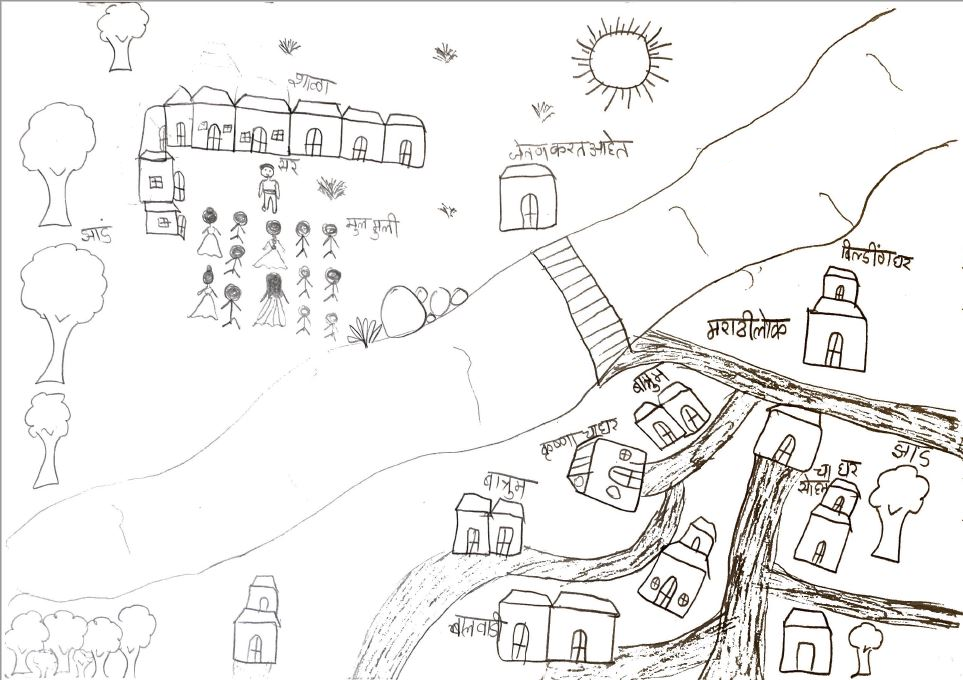
The activity to create language maps with the girls staying at Harali was an interesting experience. It is Jessica’s method to understand how people experience, perceive language use in their surroundings. Jessica is a linguistic anthropologist visiting Harali to work with us and see if we can get some insight to move the work forward with the Laman Banjara community.
The girls were bored in the afternoon. It was their day off. I had been busy visiting Tandas with Jessica and interviewing parents and teachers about language use in schooling so hadn’t found time to interact with them. With supplies spread out in their hostel wing everybody started drawing the space, people, and languages. I was a bit unsure if the task was too abstract for them but it was surprising to see the variety of ways they drew the maps.
Some potrayed places or distance, mostly from Harali, their current location. Some portrayed it as information about places neatly divided according to some theme. Others focused closer to home. Instead of different villages and Tandas they zoomed in to showcase details of spaces in and around their Tanda – temple, lavatory, school etc.
This article reminded me of a conversation on one of my research sites. A group of facilitators were discussing challenges teaching children of migrant workers in the week before. Someone says, children from other age groups are also arriving for the sessions. Many echo the same problem. The solution provided is: Patiently clarify the time assigned for their age group. Some facilitators then mention how older children come with their younger siblings. This includes older siblings as young as 3rd-4th grade and their siblings who are toddlers. The solution provided is to send them back and tell their parents to not send the toddler or both are not allowed. This is necessary to keep the quality of learning/focus during the 2 hour session. The facilitatators ask: What if the parents don’t send the child back? The answer is: that is their problem. They need their child to learn so they have to deal with it.
The realities of life for some families in this way are completely written off. As the parents and everybody of working age goes to the field, the 3rd grader has the responsibility to tend for the toddler. An urban middle class family can afford to/takes it for granted that school aged children will live their lives unencumbered by chores. In schooling this reality is taken as a given. The systems are set up with that assumption. Children are expected to be ‘care-free’. But is that really the gold standard?
Wendy Luttrell similarly talks about children of working class Americans, the expectation of school aged children to be ‘un-burdened’ by care and the reality of their perception of care duties. In a project where the children were given a camera to capture their daily lives, they captured their and others’ care work. For them it is much more than duty or obligation.
When we imagine care duties like cooking, cleaning, babysitting, taking siblings to school, looking after elderly or unwell family members, we think of it as an adult responsibility or work to be transfered to others for pay. Children are expected to be ‘care-free’. Luttrell comments that freedom thus is about not having to care. On the other hand, the children from working class families she followed, thought of “care as a concerted, collective effort that enables their own and others’ participation, learning, and sense of belonging at home and in schools”
Depending on the hamlet they lived in (the overall afluence), the children at my research site, fetched water for the use of the household, cooked, cleaned, looked after siblings, looked after domestic animals. Older children in grade 7 or so also helped their parents in the field or in the shop. Can we reimagine our learning systems to work around these tasks that are inherent part of their lives? Can we imagine a way to design the learning process that acknowledges these parts of their lives – a math problem that builds on these experiences, for example, rather than an antiseptic problem of a tap and a leaky drum?
We are almost at the end of November. The HE institutions in India with semester systems are now winding down while the ones with annual systems hopefully are settling in the rhythm of teaching online. In the beginning of the academic year, I wrote about thinking differently to achieve best outcomes for online teaching and ideas for assessment and final exams. I hope many were able to tweak their teaching strategy to suit the online environment keeping in mind their students’ background and resources.
The strategy of teaching with multiple 10 min long videos and 1 hour synchronous time per week seems to have gone well. The good part is that now the teachers have multiple recorded videos that can be reused for online teaching or teaching in flipped classroom mode after the f2f teaching resumes.
Some teachers just imported their classroom to online mode with the same hour long or longer lectures multiple times a week. Most of these teachers reported dwindling interest from students. Fatigue has set in for both teachers and students as the crucial element of classroom interaction that kept up motivation was missing. It has been especially demotivating for students without resources to attend synchronous lectures everyday. Some of the constraints for synchronous learning were: lack of a dedicated device for each person in the house, patchy data connectivity, lack of space in the house at specified time.
If you were unable to implement some of the suggestions from my previous posts, I would love to know what the constraints were. If moving from an hour long lecture to 10 minute chunks of videos seems daunting, I can help you figure out how to do it. If institutional policy is the constraint, I am happy to help redesign policies that work for all in the given circumstances keeping in mind specific constraints of your teachers and student body.
Many non-Marathi people asked if I could share a summary of the webinar or the survey report. To start with here are some points I jotted down as I was listening. Will share the report/paper when available. The webinar is also available on Youtube if you missed it yesterday. Starts with the survey report and secon half is panel discussion. You can watch two short video clips of participants at 49:35 or so. In Gormati.
What is going on with the education of children of migrant workers in the Covid times? The families move to the SugarCane fields in Oct-Nov and come back in May after the end of season. Historically, their children dropped out for this period and found it difficult to go back to school.
Jnana Prabodhini started साखर शाळा (SakharShala), short term (100 days) schools attached to sugar mills. In 2008, after the Right to Education (RTE) act it became legally mandatory for the children to be enrolled in AshramShala, residential schools or SakharShala at the premises of the sugar mills. During Covid lockdown, the AshramShalas closed down. No other educational activities were available for these children. Various waves of unlock has opened the work spaces but not the education spaces. It is time for the workers to migrate. As the AshramShala is not open yet, the children will go with their parents and will not return to school till May next year, effectively losing an entire school year.
JPP Harali center was working with AshramShala students focusing on specific aspects of development before the Pandemic. The insistance on expression in student’s own language made these programs very successful. After the lockdown in March 2020 students returned home and have been out of school. The survey was an effort to understand the current situation. The survey focused on basic information of each migrant hamlet, specific information about the families, and understanding educational needs of 10-12th grade students. With the survey questionaire, the exercise was also used to have candid conversations with people of all ages. The survey was conducted in 30 hamlets in 3 Districts of Usmanabad, MH – Lohara, Tulajapur, Umarga.
Some findings: – Afraid of school although also reverance. School loved for playing games. Afraid as they have not got the educational materials and have not done the exercises received on mobile phones. – Overall, fathers were indifferent while mothers were more worried/passionate about lost education. Older people acknowledged that it was the first generation that had managed to stay in school and school shutdown has reversed the situation. – If something is not done sooner, students will not return to school. Students have forgotten what they learnt and joined parents in the fields. – Gender specific – Girl students will be married off while young boys will join the labour force. – Online education is an alien concept. Most do not have mobiles. 77% have been completely out of touch with their school education. 10% received books but no instruction or visits. 12% have managed some education through mobile or TV. – 48% families will take the kids with them when they migrate, out of which 14% will take some kids and leave some kids back with elders. Even if schools start later, the children will not be around to go to school. However, If school starts in Dec-Jan, 78% families are ready to send their children back. – Reasons to take children with them: 59% families do not have elders/relatives who will stay back to take care of children left behind. 19% families expect their grown up children to work with them in the field.
Panel Discussion: Abhijit Kapre: Education (or lack thereof) of children of sugarcane migrant workers is not a new problem. Many organizations are working on it. How has Covid affected/exacerbated the situation. Note: following are some interesting points from the panel discussion. not a summary.
Pravin Mahajan: Covid has not changed the situation much for this population. Migration is not going to stop. In the last decade their is recognition that this situation exists. Instead of thinking of stopping it, it is necessary to build systems acknowledging it. Children should not be separated from parents till 8 yrs of age. It is not advisable to stop children from going with their parents. The problem is not migration but lack of resources at the site of migration.
Nutan Baghade: Brought up other facets of keeping children in school – need to work with parents and not just students. Gave examples of variety of schemes that stopped migration. Gender issues – early marriage is a major issue in Marathwada. Need concerted effort on village level. Need for dialogue with parents of girls around 8th grade. Ensuring safe spaces. Parents do not want girls to go far from home so distance from home becomes a major variable for dropouts. Need to work with boys to make spaces safe for girls. Note: YoungLives working paper based on study of schools in Andhra Pradesh has identified Distance from school as a significant factor in school dropouts at secondary level “more dropouts are observed before completing secondary education in communities where a public high school is more than 5 km away (36.4 per cent), compared to communities where the school was closer (23 per cent).”
Prakash Ranavare: Residential schools at the sugar mill with parents visiting on the weekly breaks did not work. Parents did not trust/like to keep younger kids away from them even during week days. Suggested schools midway from two mills and students travelling to school every day. Following the migrant group and educators meeting them where they are, has worked in some places (Theur??) but do not have enough people to do it in other places.
Pravin: Should not worry too much about गुणवत्तापूर्ण शिक्षण. Children who are 4-5th generation students vs students who are 1st or 2nd generation unfortunately have the same syllabus. It is not useful for either. Need to rethink what is quality (गुणवत्तापूर्ण) education for 1st generation children. If they stay with education and enjoy it, you can say it is quality. सर्वांगीण विकास – all round development is the key. Note: I agree with the all round development but expecting less from 1st generation students is a slippery slope/recipe for widening the gap. This kind of low expectation bias is what did in the black students.
Some excerpts as I was reading the NEP “moving towards a higher educational system consisting of large, multidisciplinary universities and colleges” “build vibrant communities of scholars and peers, break down harmful silos, enable students to become well-rounded across disciplines including artistic, creative, and analytic subjects as well as sports, develop active research communities across disciplines including cross-disciplinary research, and increase resource efficiency, both material and human, across higher education” “10.2. Moving to large multidisciplinary universities and HEI clusters is thus the highest recommendation of this policy regarding the structure of higher education”
Thinking out loud about the experience at Columbia University with respect to multidisciplinary coursework and research: IGERT experience Some fields do better in interdisciplinary research probably because there are already some pathways for them – Bioengineering, biochemistry for example. The Architecture and Engineering IGERT however struggled. Different ways of teaching and learning, different value systems (nursing and medicine), unavailability of venues to publish research (Engineering and Architecture) were some of the challenges.
Creating coursework School of Nursing and School of Medicine when creating an online course could not agree on how to read test reports (therefore how to teach how to read reports) – the basic assumptions about relationship with patients or their positionality with respect to patients differed so drastically that it was almost impossible to decide the ‘right’ course of action as the students walked through the cases presented.



 devayani tirthali