Musings

All the Marathis

My first exposure to Vijaywada and the language environment of my new home was a conversation with the uber driver. We interacted with help of our mixed repertoire of English and Telugu. I do not speak Telugu (yet). He taught me some useful everyday terms. I told him about Telugu I have heard in Hyderabad. Then the conversation moved to the different Telugu s. The Vijayawada Telugu is the pure Telugu he said and then proceeded to explain the differences with other regional versions with everyday examples. The forms of verbs, the intonations, some words that differ.

That conversation stayed with me because it made me think about a similar possible conversation with a Puneri person. Many times Marathi Praman Bhasha is equated with the formal register. However, there is an added layer of regional hierarchy. The Puneri Marathi and its formal register are Praman. The formal register of the languages in other regions are still not up to the mark.

When I refer to formal register I am talking about language spoken at formal occasions rather than everyday speech. Formal does not mean pure. It only means situational. Other registers could be spoken vs. written. Then there is the difference between written to friends, colleagues, boss, vs government/official/legal notes.

These registers are just the way we speak/express depending on where we are and who we are speaking to. It is not about correct or incorrect language. The problem starts when we see it as a hierarchy and treat one register as ‘proper’ or shuddh शुद्ध (pure) language. In doing so we have forgotten the regionality of the Puneri Marathi register.

If Praman Bhasha were truly neutral, who would feel most at home in it—and who would feel most exposed? Puneri Marathi quietly standing in as neutral or pure or the original untainted marathi, makes distinctions between registers not just functional. They are moralised. Speaking or writing differently is no longer just “informal” — it becomes “lazy”, “incorrect”, or “uncultured”.

Thus when a child, a teacher, or a community speaker is told their Marathi is ashuddh अशुद्ध, what is really being corrected is not grammar but location, physical and social.

Related Reading:
All the Englishes by Akshaya Saxena: She talks about helping students in her literature class question “how language itself shapes our ideas about ownership and belonging” with the help of Amy Tan’s essay ‘Mother tongue’.

Musings

The Need to Pass

Yesterday one of the speakers at the Vimukt Diwas conference mentioned how some Banjara (or DNT?) youth borrowed money to go to Ayodhya for the Ram mandir inauguration, while the families did not have enough money for two square meals or to continue their education. What makes people make these decisions?

There was a discussion on false consciousness and how this keeps DNT in the cycle of poverty and exploitation. The point of the conversation was that people are misled by dominant ideologies into acting against their own interests. However, instead of asking why do people act against their interests? I would like to think what kinds of recognition are made available to them, and at what cost?

I have been thinking about this for the past few years with reference to the conversations in the Anandshala project. Two conversations stand out:

When interviewing Banjara students about their language use, one student said, it is obvious that nobody would like to learn his language, it is filthy. There are swear words. Marathi is much cleaner. The remark was delivered in a matter of-fact way.

A few months back waiting for the inauguration ceremony of Anandshala container school in a vadar vasti, I was chatting with the parents and grandparents of the children. One grandma mentioned that she just dropped her grandson in a residential school. Among the two, one was very boisterous and unruly. She was worried about वाईट संगत if he stayed home. The other one was quieter, brighter. अगदी बामनावाणी बोलतो. The teacher at the residential school promised that he will straighten the boisterous one after a year, after he gives him time to settle down.

These are not isolated anecdotes. The pressure on marginalised communities to demonstrate worthiness by aligning themselves with dominant norms of speech, behaviour, belief, and discipline are evident in everyday moments as well as institutional processes. Hegemony works not through force alone, but through consent: through everyday practices of aspiration and common sense.

These three instances are examples of investments in symbolic capital. Attempts to convert marginality into recognition, however fragile that recognition may be. The problem is not that people want to pass. It is that passing has been made a prerequisite for dignity.

Musings

What does it take to pass?

One of the Anandshala facilitators during a conversation proudly shared that people say “you don’t sound Laman”. For her, not sounding x is a marker of upward movement socially. Like in Shaw’s Pygmalion or P L Deshpande’s Fulrani, what does it take for a flower girl to pass off as an elite lady?

She grew up in the district headquarter, not in the Tanda. Her Marathi is learnt as a Parisar Bhasha among various marathi speaking people, not as a language of instruction or a subject in school like her students. For a person visiting from Pune, the keeper of ‘standard Marathi’ she will sound rural or not (so called) higher caste. Markers such as न and ण would be obvious to them. Those she did not learn by osmosis in her semi-urban environment, but only in the school. When we look at language as performative in that sense – where and how one learns it makes or breaks the performance.

Why do people find the need to pass; what harm such compulsions rooted in social structures cause; and what can we do personally and as a society to not put that burden on them is a conversation for another day.

Musings · Social Media, Technology & Education

Endangered Home Languages

Working with the Laman Banjara children in Anandshala, we have been exploring various facets of the problem आपली मुलं शाळेत फुलत का नाहीत? [why don’t our children prosper in school]. A couple of years back we talked with the parents, children, and the teachers about language transition from home language to school language – their experiences, what they think works and does not work.

As educators, learning scientists, linguistic anthropologits, we think that it is important to support the home language. Use it in verbal exchange in formal and informal learning spaces; create learning material in the home language; encourage translanguaging. While parents want their children to quickly move on to Marathi and English. When asked “don’t you worry you will lose your language?” The answer was – “We talk in our language at home. It will not disappear. But the children need to learn English to get a job in the office and change their plight.”

An article on Kolami speaking community in PARI reminded me of this exchange. Kolami is named as an endangered language by UNESCO. But the speakers have more pressing issues than saving their language:

“There is no time to think about anything else [other than her farm],” she says about the status of Kolami as an endangered language. When Sunita and her community didn’t know fluent Marathi, “everyone would say ‘speak in Marathi! speak in Marathi!’” And now when the language is endangered, “everyone wants us to speak in Kolami,” she chuckles.
“We speak our language. Our children too,” she asserts. “It’s only when we go out that we speak in Marathi. When we come back home, we speak our language.”
“ Aapli bhasha aaplich rahili pahije [Our language should remain ours]. Kolami should be Kolami and Marathi should be Marathi. That is what matters.”

The Kolami Speakers of Yavatmal.

It is the exact same discourse. When there is urgent need of improving dire living situation, saving home language or the identity formation of the child in the first five school years based on home language, and all the theories of learning are not a priority.

Working with the community as a participatory practice rather than an intervention, where do we stand when our beliefs about primacy of home language butt against the basic struggle to stay alive?

Musings

Lost in translation

As we travel, interact with people of different states, translate and re-translate colloquial names of vegetables and food ingredients, it has turned into a proper mashup. It might also be as some of us have lost the link between growing and consuming. It might come across as nit-picky when I correct word usage but in less than 10-15 years wrong usage of some of the words has become more and more embedded, especially as Google keeps compounding the initial error. Here are some examples.

Lentils: Masoor. For some reason this word is used to mean Daal or the split version of any legume. For example ‘lentil fritters’ is used for bhaji, it may or may not be masoor flour. In most cases it is chickpea flour. I thought it was a problem in the USA, but I see that now in Delhi as well. It is problematic in practice as all Daals are not made equal in terms of taste as well as digestibility.

Laal Math: A type of Amaranth. I have seen it translated as ‘red spinach’. It is nowhere close to spinach. Spinach is Spinacia oleracea and red amaranth or लाल माठ is from the genus Amaranthus. The usage probably started because of colloquial usage of the generic word Keerai in Tamil that is translated as spinach instead of ‘green leafy veggies’. That is where the word Malabar spinach (Basella alba) originates from, another vegetable that is nowhere close to spinach. I realized this goof up when I ordered spinach seeds from a south Indian grower and ended up with Amaranth seeds. Unfortunately now if you google laal bhaji or red spinach you will get boatloads of

ओव्याची पानं / Indian Borage / omavalli / Ajwain patta: The plant with leaves that smell like carom seeds. This has created so much confusion on OTG groups everywhere. People trying to grow Indian Borage (plant with leaves that smell like carom seeds) with carom seeds. Correcting the misconception is my pet peeve. The confusion started because of the name “ओव्याची पानं” literally carom leaves, instead of “ओव्याचा वास असलेल्या पानाच झाड” literally the plant with leaves that smell like carom seeds. The leaves of carom plant are

The colloquial names for plants if not matched with the colloquial knowledge of plants – the way they look, smell, their texture, the season they are available, how to grow them if not self seeded, and how to cook/use them – then a lot goes wrong in translation.

Musings

आमची भाषा Our Language

When listening to Prof. Wei’s speech yesterday, his use of the phrase ‘named languages’ really resonated with me. It reminded me of multiple instances and observations over the couple of years interacting with ‘Gormati’ speaking people. Prof. Wei was talking about Translanguaging for inclusion and social justice.

The second year of working with the Laman Banjara people, some of the students from Anandshala came to stay at Harali temporarily while their parents were away for sugarcane harvest season. Hematai was working on creating an English-Gormati bilingual picture book with them. She had worked with students at Harali before, to create an English storybook with visuals. The students themselves came up with the story and had drawn visuals themselves. Similar to the previous project, we started with some storytelling sessions.

In the first session, students were asked to narrate Gormati stories that could inspire a narrative for the book. A girl next to me asked another: “कांइ बोले छ?” (What are they talking about?)
“म्हन्जे हापल्या भाषेत बोलाच” (That means we speak in our language”).
Did that mean not everybody refers to the language as Gormati? So I asked the students afterwards – what do you call the language you speak in?
There was a confused pause. आमची भाषा? (Our language?)
There had not been a need to name the language they spoke. There was no situation where they had to talk about their language as a thing. They interacted amongst themselves a certain way and in school they had to learn Marathi, a named language and a subject of study. We had created the need to name by asking questions about their non-Marathi practice.

“Named languages are abstractions from social activity of languaging. It is the linguists who socially constructed languages and gave them names.”

– Prof Lee Wei, February 2023

When interviewing parents last summer about language practices, we saw the same thing. After the experience with the students I had started asking questions with the phrase ‘घरची भाषा’ (home language). It worked well as we were talking about how their children transitioned from home language to language of instruction in school. If I didn’t use the word Gormati then most referred to it as आमची भाषा (our language).

In other instances, when asked to speak in Gormati, a couple of facilitators and students who had lived outside the Tanda for an extended period, were anxious. They claimed they could not speak in Gormati. However, observing their natural languaging practice I realised that they go in and out of Gormati and versions of Marathi (peppered with everday English words) when at home or speaking with their peers. Naming their languaging practice probably pushed them to acknowledge their practice as different from ‘standard’ Gormati, whatever that meant for them.

Naming the language in this way created these abstract buckets of Gormati and Marathi as if these were distinct parallel monolingual practices. The biggest struggle moving forward for us at Anandshala is going to be acknoweldging the translanguaging practices, working on the perceptions all of us have about language practice and related power equations, and figuring out what it means for classroom/languaging practice in Anandshala and Anandghar space.

Musings · Social Media, Technology & Education

My language, your language, our language

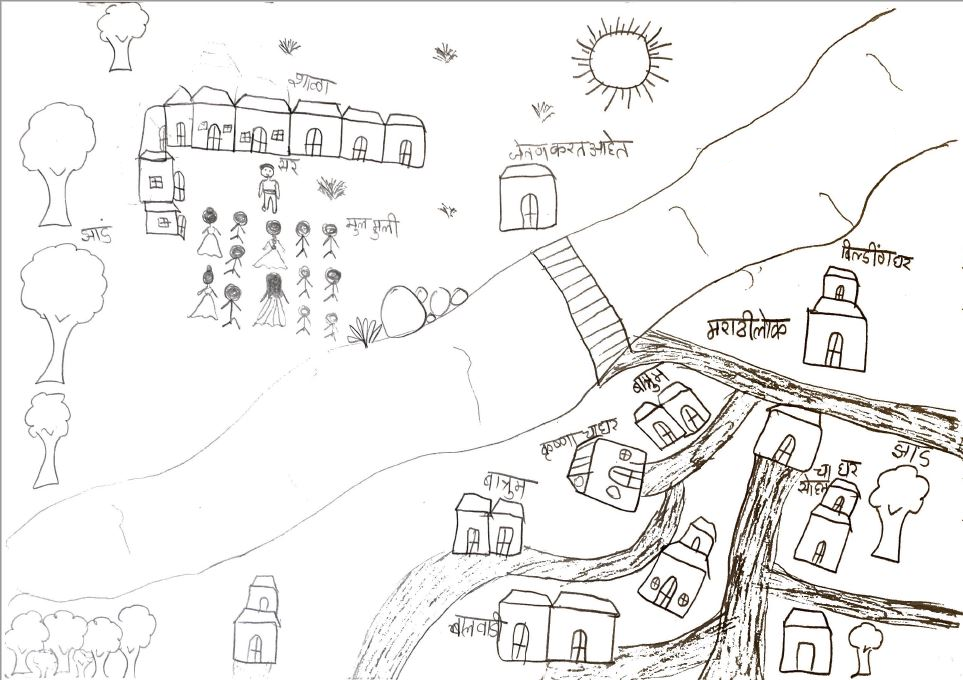
The activity to create language maps with the girls staying at Harali was an interesting experience. It is Jessica’s method to understand how people experience, perceive language use in their surroundings. Jessica is a linguistic anthropologist visiting Harali to work with us and see if we can get some insight to move the work forward with the Laman Banjara community.

The girls were bored in the afternoon. It was their day off. I had been busy visiting Tandas with Jessica and interviewing parents and teachers about language use in schooling so hadn’t found time to interact with them. With supplies spread out in their hostel wing everybody started drawing the space, people, and languages. I was a bit unsure if the task was too abstract for them but it was surprising to see the variety of ways they drew the maps.

Some potrayed places or distance, mostly from Harali, their current location. Some portrayed it as information about places neatly divided according to some theme. Others focused closer to home. Instead of different villages and Tandas they zoomed in to showcase details of spaces in and around their Tanda – temple, lavatory, school etc.

You can see a couple of their maps here.

Related reading:
Chandras J., Tirthali D., and Dabak P. (2023). Mapping Multilingual Sociality in Rural India: Children and Youth’s Perceptions of Self and Language in Space. Communication in the Worlds of Children and Youth: Imagination, Language, Performance, and Creative Expression

Musings

Storytelling, yours and mine

The second year of working with the Laman Banjara people, some of the students from Anandshala came to stay at Harali temporarily while their parents were away during the sugarcane harvest season. Hematai was working on creating an English-Gormati bilingual picture book with them. She had worked with students at Harali School before to create an English storybook with visuals. The students themselves came up with the story and had hand-drawn visuals. Similar to the previous project, we started with storytelling sessions. Students were asked to narrate Gormati stories that could inspire a narrative for the book.

We sat in a big circle. There was a lot of excitement and a buzz of students talking amongst themselves to figure out which story was worth sharing. A few students came forward to stand in the middle and tell a story. All of them chose to tell the story in Marathi. Most of the stories could be readily identified as the ones read or narrated in Anandshala. Hematai wanted to get to the traditional stories, that they heard from their grandparents. Stories that were specific to their people.

The next instruction was to write stories with an emphasis again on Gormati stories. The next session started with some more stories in Marathi, again mostly from the Anandshala repertoire. Hematai asked if anybody had a Gormati story. A cheeky student got up and started reading from his notebook. I had seen his writing before, so seemed like he was reading his story written in Marathi and translating in Gormati on the spot. The point of getting to the ‘traditional stories’ was lost.

Next session was about seeing different storybooks for inspiration and telling/writing new stories they had never heard of. Something that they created themselves. One student came forward with a story of a mother elephant and a baby elephant. The story was a reflection of his home life combined with the story books he looked at for inspiration – animals in the forest. The story started with the mother elephant going to work leaving the baby elephant alone, the dangers involved, the hunger, the loneliness, animals tht helped and animals who wanted to ause harm. It took myriad paths settling down at some point on how with all the money that the mother earned, they were able to build a 3 storey house full of all the amenities. In short the reality of his life, the inner struggle, and his aspirations described through the elephant family.

Being part of these storytelling sessions was instructive. There was a specific expectation in the objective of getting to the Gormati stories. The expectation was that it will extract the ‘traditional’ stories. The assumptions about traditional stories probably coming from the discourse of a grandma telling stories specific to the community; or the Panchatantra as the proxy for the oral tradition of fables, stories told in guise of interactions of animals, to teach moral lessons; or the mythological stories of Ramayan, Mahabharat, or Puranas.

Is that an assumption based in specific space (urban-rural, home-school) and people? Did these children grew up listening to bedtime stories from their parents or grandparents? Or did they read a story in this particular format only in school?
In regular interactions or even in purposeful interactions like interviews, I have heard both children and adults express their opinions, experiences and such in a narrative form rather than a statements. What does that say about storytelling in this community?
What about the songs for various occasions? They are mostly stories of past and future anxieties or aspirations. For example, a women’s (mother’s??) song after a wedding describes in detail how the mother-son relationship was before and how it will change after the wife is part of the picture.
What other interactions are we missing, that we need to see? What questions can we ask, what spaces can we inhabit to see these practices?

If we are trying to acknowledge / bring in the stories of the student’s specific communities in an effort for inclusion, or to make space, can we bring in these practices and help students express their stories in the formats ingrained in their regular practice, in addition to introducing the formats and ethos of the Panchatantra stories?

Musings · Social Media, Technology & Education

Growing up

Going through all the old stuff at my mother’s house has been an education in how privileged my life was in terms of at least one parent taking active interest in my education and Marathi language development. Previously I wrote about the newspaper cuttings of poems. Poems that she taught me to enact. During the recent visit we found a poem she wrote herself to teach us about fruits. I remember enacting, in fifth grade, a story she wrote. It had a somewhat sad ending but taught me about ethics and not making assumptions about people. Simple lessons that have served me well my entire life. She used to write speeches for me for ellocution competitions as well. I particularly remember the one she wrote for B G Tilak’s Jayanti – an age appropriate story from his childhood depicting his independent spirit.

This one looks like a poem written for a much younger age. Focused on interesting sounds and imagery – खाड खाड बूट आपटत , अंतू चिंतू मंडळी, लट्ठमभारती पोंक्षे etc. You can see extra lines scribbled in the margin probably to include some fruits missed in the first effort. Here is the complete poem:

फळांची ओळख
बंडोबान काढलं फळांचं दुकान
फळं घ्या फळं गोड ताजी छान
लोकांना मिळाली वर्दी
दुकानात झाली एकच गर्दी

काठी टेकत टेकत आले मिस्टर तांबे
खोकत खोकत म्हणाले कसे डझन आंबे
अंतू चिंतू मंडळी, पाहून आली जंजीर
बंडोबाना म्हणाली गॉड आहे ना अंजीर
सुलू ताई आल्या, बरोबर होती कुक्कु
म्हणाली आई मला नको काही, घे फक्त चिक्कू

खाड खाड बूट आपटत आले दोन शिपाई
ऐटीत राहूंन उभी, मागितली पपई
डुलत डुलत आले लट्ठमभारती पोंक्षे
सीझन नव्हता तरी म्हणे हवी मला द्राक्षे

सकूटर थांबवत थोडी म्हणाले सुरेश मंत्री
आहेत का हो तुमच्याकडे नागपुरी संत्री
विद्याताई आली साडी नेसून डाळिंबी
आजोबांसाठी तिला घ्यायची होती मोसंबी
प्रतिभाची मुलं म्हणे खात नाहीत भाजी पोळी
शिकरणाला हवीत तिला रोज घरात केळी

यमुनाताईंची सदा घाई, दोन हवे अननस
लवकर द्या हो नाहीतर चुकेल माझी बस

बंडोबान काढलं फळांचं दुकान
माल गेला संपून व्यापार झाला छान

Musings

Amchi Marathi

Last weekend we attended the Triratna Mahotsava a three day festival honouring the three Marathi artists – Sudhir Phadake, Madgulkar, and P. L. Deshpande, in their centenary year. This is the second major event organized by Dilli Marathi Pratishthan. I am amazed at the level of organizing and greatful for the apportunity to attend the programs free of cost.

A few references however were instructive of who were assumed to be the ‘Marathi’ people in audience. A few conversations revealed how the others were painfully aware of it.

अत्रे, पु. ल. यांच्या  लेखनावर पोसलेली पिढी was something that really drove home the ब्राह्मणी बाज of the presentation. A snarky comment about how people speak in Marathi now-a-days – मी आली मी गेली or मला कागद भेटला नाही instead of मिळाला नाही. The examples showed how clueless presenters were about language use outside their circle.

Praman Bhasha or standard Marathi. Who decides the standard? For Marathi the Puneri brahmani marathi has been the standard. Other linguistic practices are considered to be dialects or ill spoken, गावठी, not pure.

During the tea break, a couple sharing our table was talking about the jokes related to ‘marathi nowadays’. The wife said his Marathi is mixed with Hindi as he is from the borderland. The husband said, “no, that is how we speak Marathi. It is not a hodgepodge of marathi and hindi I am speaking.”

My comment that it was a very puneri, kokanastha brahman kind of snark and is insulting, was overheard by a गोरे घारे पुणेरी uncle. “you really feel that?”, he said perplexed. I remembered my mother once told me the story of how it was mindboggling when she realised that nobody other than her knew about PL in her class of Mphil, A cohort of people from different states in an institution in Pune. PL, a writer she thought was world renowned. And she realised how small her world was. I hope the gentleman thought on the same lines rather than taking it as a personal attack.