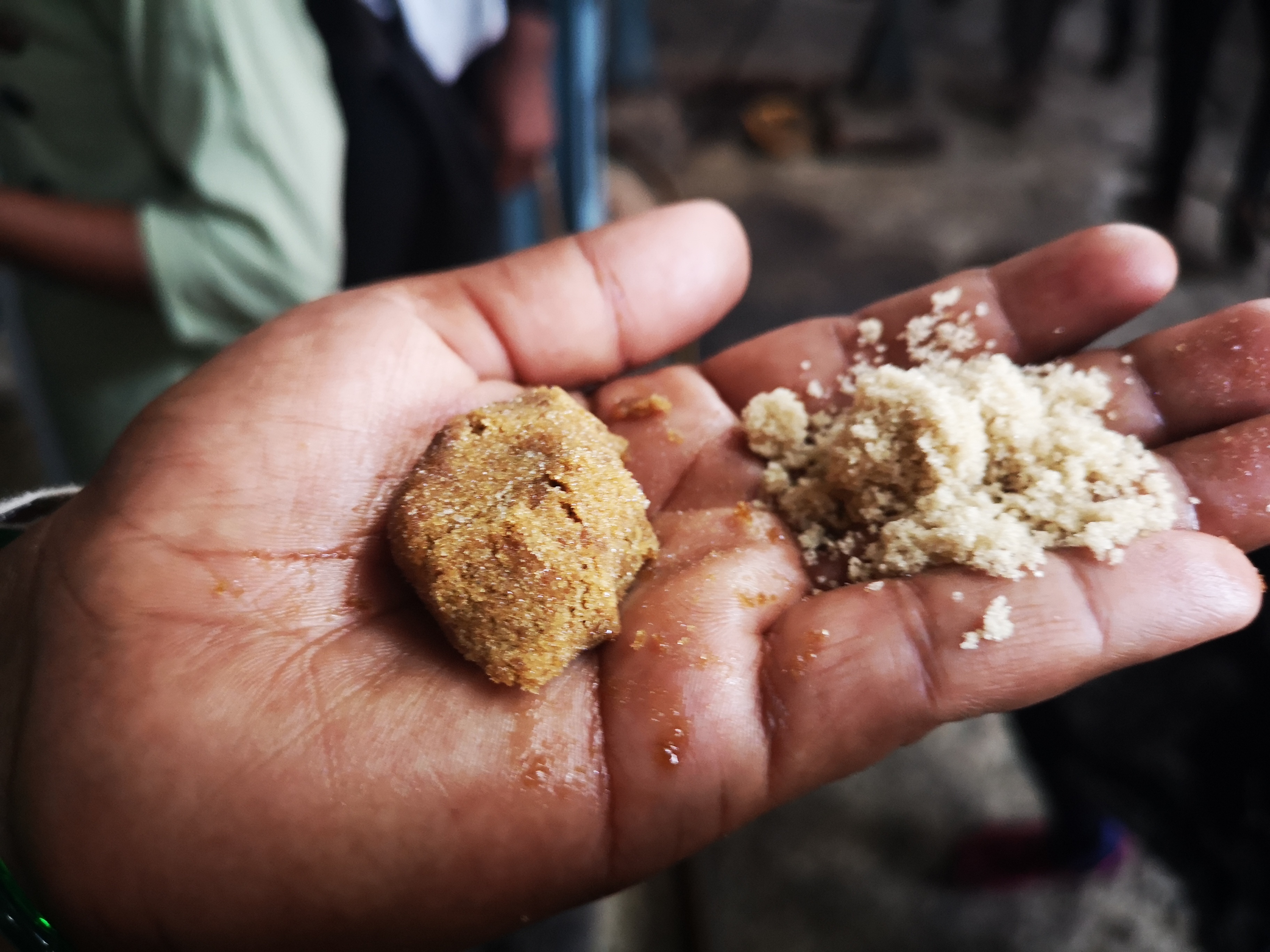
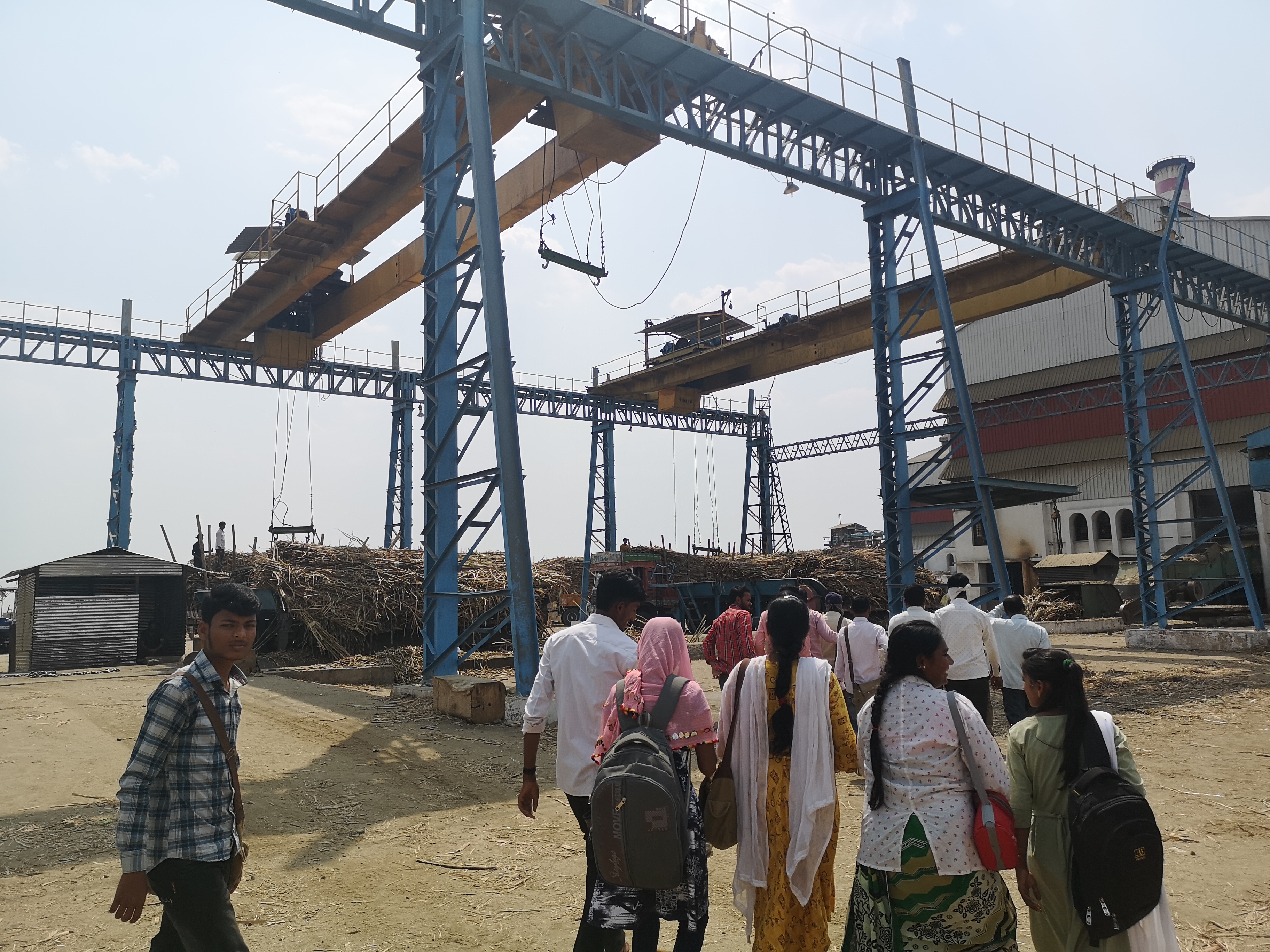
People from the Laman Banjara community visit a sugarcane factory as part of their teacher training workshop. Some of them who have worked as labourers during sugarcane harvest season in harsh conditions, have never been inside a sugar mill they work for.
This was an interesting eye-opener about how the discourse of learning-loss with respect to students feeds into the deficit mindset.
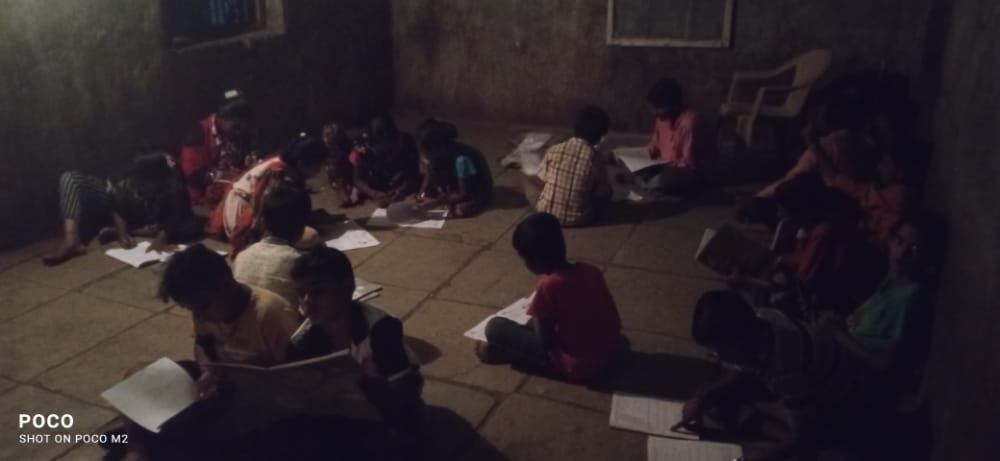
The middle school boys from Bhosga last year who took harvest contracts and earned money during the pandemic, we see you. We see that you are doing your best to learn from life and thrive in the present circumstances. We see you now coming in for the Anandshala everyday late at night after a days work. Especially the girls who have the added responsibility of the household chores. Prithvi, we see you, working the whole day and then teaching the kids in the evening with so much enthusiasm. Managing in a room without a door, taking the light bulb with you every night so that vandalism would not affect the learning on the next day. We acknowledge you attending the facilitator’s meeting on the phone while you were harvesting soyabean.
Although the video referes to the American educational system, the discourse is no different in India. The rhetoric of skill-loss or learning-loss is all pervasive with the AP report and a variety of education experts commenting on it primarily as they build an argument for schools to open again.
I am not against schools opening. It is necessary in most places. However, focusing on the skill loss puts us (teachers, policy makers, administrators, education experts) on the defensive. Can we acknowledge that the children lived through a pandemic just like we did. They learned to live in a pandemic, they survived. Can we plan teaching and learning acknowledging the fact that each child brings something to the table? It is not just the teachers or the people who design the curriculum that have things worth giving.
Schools are not the only places learning happens. Children coming back to school are not leaky buckets left half empty that teachers now have to fill upto capacity with herculean efforts. Pandemic did not freeze them in place. Just like all of us adults, they lived through it. Lets try to connect back with that experience in mind.
This article reminded me of a conversation on one of my research sites. A group of facilitators were discussing challenges teaching children of migrant workers in the week before. Someone says, children from other age groups are also arriving for the sessions. Many echo the same problem. The solution provided is: Patiently clarify the time assigned for their age group. Some facilitators then mention how older children come with their younger siblings. This includes older siblings as young as 3rd-4th grade and their siblings who are toddlers. The solution provided is to send them back and tell their parents to not send the toddler or both are not allowed. This is necessary to keep the quality of learning/focus during the 2 hour session. The facilitatators ask: What if the parents don’t send the child back? The answer is: that is their problem. They need their child to learn so they have to deal with it.
The realities of life for some families in this way are completely written off. As the parents and everybody of working age goes to the field, the 3rd grader has the responsibility to tend for the toddler. An urban middle class family can afford to/takes it for granted that school aged children will live their lives unencumbered by chores. In schooling this reality is taken as a given. The systems are set up with that assumption. Children are expected to be ‘care-free’. But is that really the gold standard?
Wendy Luttrell similarly talks about children of working class Americans, the expectation of school aged children to be ‘un-burdened’ by care and the reality of their perception of care duties. In a project where the children were given a camera to capture their daily lives, they captured their and others’ care work. For them it is much more than duty or obligation.
When we imagine care duties like cooking, cleaning, babysitting, taking siblings to school, looking after elderly or unwell family members, we think of it as an adult responsibility or work to be transfered to others for pay. Children are expected to be ‘care-free’. Luttrell comments that freedom thus is about not having to care. On the other hand, the children from working class families she followed, thought of “care as a concerted, collective effort that enables their own and others’ participation, learning, and sense of belonging at home and in schools”
Depending on the hamlet they lived in (the overall afluence), the children at my research site, fetched water for the use of the household, cooked, cleaned, looked after siblings, looked after domestic animals. Older children in grade 7 or so also helped their parents in the field or in the shop. Can we reimagine our learning systems to work around these tasks that are inherent part of their lives? Can we imagine a way to design the learning process that acknowledges these parts of their lives – a math problem that builds on these experiences, for example, rather than an antiseptic problem of a tap and a leaky drum?
 devayani tirthali