Nainital was in news end of April due to forest fires that came too close to the residences and the army campus. I explored more as we were planning to visit the Kumaon region in May. Realised that forest fires in the Garhwal and Kumaon region during this time are a regular occurance. It just ended up in news because it was out of control and threatened Nainital proper. The visual of the helicopter lifting water from Bhimtal to dump it on the forest fire was newsworthy.
Among a variety of reasons, some pointed the finger at miscreants, cattle grazers who set fire to prompt new grass, campers and tourists who accidently set fire; some talked about the weather this year – it has been a dry winter. No snow, no spring rains. Everything is dry. There was also a mention of pakistani elements sabotaging. Of course somebody has to bring up our neighbour. One thing was missing though, the fodder provided by the Chir trees and the history of it.
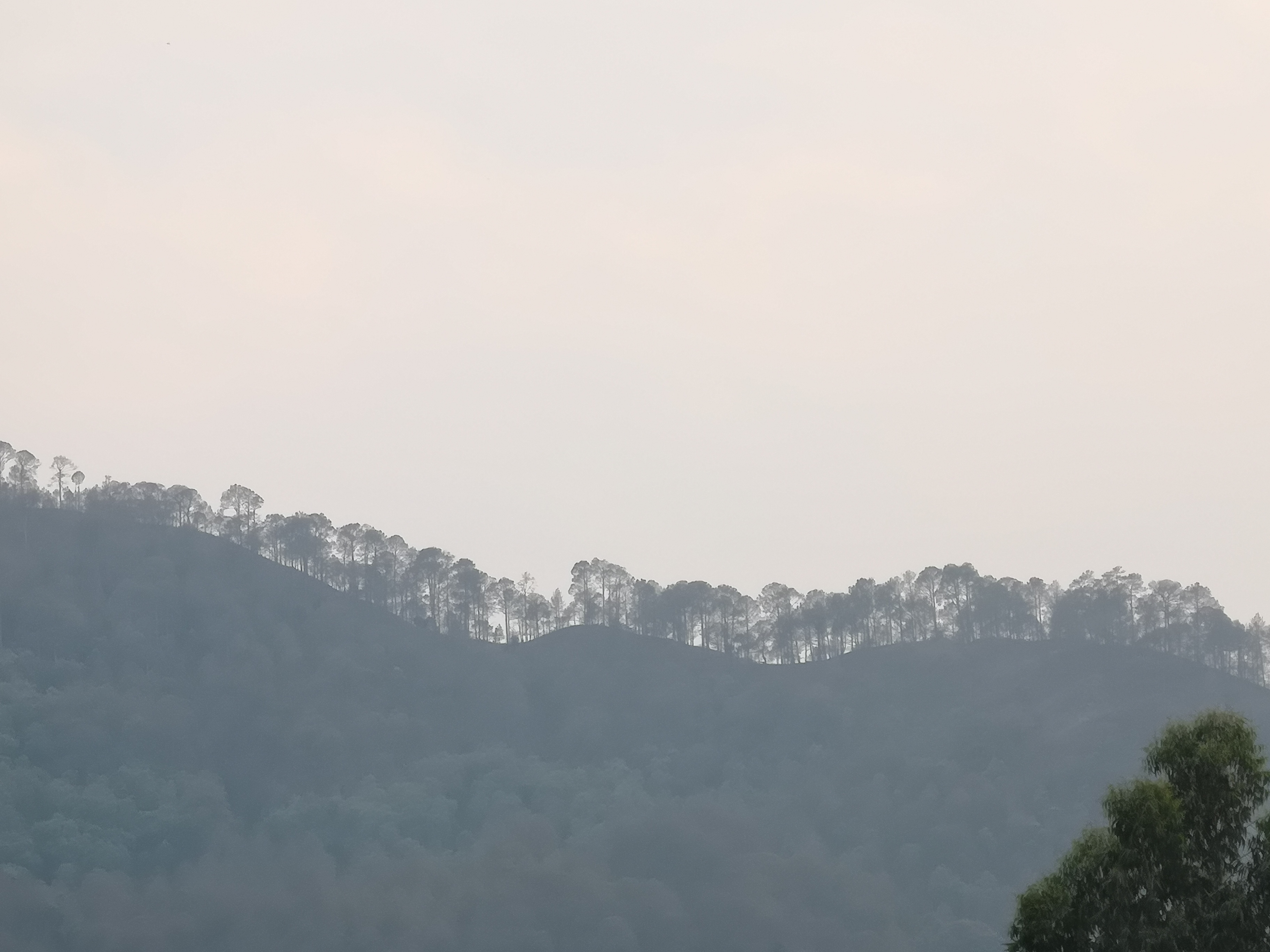
Chir or Pine, the straight tall trees, that create the beautiful picure perfect silhoute of the moutains are highly flamable. Their needles cathch fire very quickly. Our taxi driver said, the wet/green leaves/needles are flammable, once they are dry, it can be ignited with just a stone falling on another stone. We saw a demonstration immediately after at a rest stop. A driver (obviously an outsider) threw a cigarette butt and walked ahead, unaware of the fire ignited behind him.
The mono-culture of Pine (Pinus roxburghii) is a colonial legacy. It was grown for its straight wood and the resin. Kathgodam, the last train station, entry to the Kumaon region gets its name from this history. It was a depot that transported Pine from the hills to the seaport of Calcutta. When we were in the Garhwal region in the Fall, our treck guide had talked extensively about the nuisance that is the Pine tree. The tree does not allow any other tree to grow around it. It has shallow roots leading to soil erosion, it dries up land and makes it barren. The needles are flammable, cover the ground and makes it acidic so that nothing else grows on it. Rhododendron and the Banj Oak are two of the species that can push back. The Banj is a multiuse tree of the region. Offers shade, fodder for domestic animals, the leaf litter makes the land fertile, the cones are edible, branches are used as cooking fuel. However, its wood is not useful for furniture. It is also a slow growing tree. Thus over the years it has been replaced with the Pine.
This 200 year old story still haunts the hills every summer with forest fires. It has also made the soil increasingly dry and infertile, and the hill slopes barren.
Relevant Reading:
- British Colonial System and the Forests of Garhwal and Kumaon Himalayas: Consequences of Colonial Intervention in the Himalayan Society by Surendra Bisht.
- Dangerous Beauty: The Story of Pine Trees in the Himalayas by Aayush Malik.
 A woman getting one prepared for her daughter’s first KarvaChauth gave me a low down on other things that will go with it as a gift inclusing diamand jewelery for daughter, gold something for the son-in-law etc with a price tag of 1 lakh. The Mathris seemed like the cheapest but traditionally most important part of the gift. I was told a Sargi or a food and puja item basket which includes mathari is sent by the mother-in-law to the daughter-in-law. Not sure if this was the same.


 devayani tirthali