Social Media, Technology & Education

Random thoughts on Plagiarism, literature reviews and such

It is getting really frustrating to get requests to edit/review thesis or literature review that actually expect me to write most of the document or rewrite copy pasted chunks so that they are not caught by softwares like TurnItIn. The requests come from people supposedly in North America or Europe. So before you jump in and decide it might be a third world country problem, it is not.

I am perplexed. Do these people not know that it is unethical or they do not think they will get caught or may be there are no repercussions? I voiced this frustration while chatting with a group of school friends. One of them an established scientist in US now. She completed her Masters in India before going to US to complete her Doctorate. She commented that she did not know about plagiarism or how to do a literature review till she wrote her first paper and was told not to do a patchwork copy paste work like that again. She had a better mentors who eduated her. However, I also know another story from Columbia University, my alma mater where computer science students got in serious trouble for using part of code from each other.

Is nobody teaching students how to conduct or write literature review along the way?

I try to remember where/when/how I learned it. It is difficult to pin point now after all this time and it has become so everyday. Probably learned along the way in multiple courses, or watching other senior researchers may be?

One specific overtly designed experience I remember was in Prof. Lin’s class on Metacognition. She asked us to summarize the paper as per a structure, a table or a form she had provided. By second or third week we learnt to give a quick read to the assigned papers for the week and pick up the most important points instead of getting stuck in the weeds. I also remember writing literature reviews as part of class assignments for at least 2-3 subjects.

Musings

Election time

There has been quite a stir after the state elections of Telangana, Madhya Pradesh, and Rajasthan. BJP suffered heavy losses making people wonder how they will fare in the Loksabha elections coming up in 2019. We will be voting after a long absense in the country, so I am watching how things are unfolding.

What I think is more important than the BJP defeat is the revival and increasing importance of regional parties rather than the national parties. In Telangana the Telangana Rashtra Samiti (TRS) won 88 of the 119 seats. His political ambition seems to be forming a front of regional parties to contest Loksabha election. Mizoram elections from Novemebr 26 did not cause as much stir as the BJP being ousted from the ‘Hindi belt’ states (Chhattishbargh, Madhya Pradesh, Rajasthan) in the recent one. [I abhore the term Hindi belt, but more on that later].  Mizo National Front (MNF) won 28 of the 40 seats in Mizoram, in comparison to 5 for Congress and 1 for BJP.  In Rajasthan, the news of course is the ousting of BJP, but if we look at the other contenders, Beniwal’s  Rashtriya Lokatantrik Party (RLP), floated a month before the election after breaking away from BJP won 3 seats. They also got sizable votes in some districts they did not win, which ended up deciding the winner between Congress and BJP.

There is the caste, religion angle to all these, but I think the most impportant is that they are regional parties. Some think that a strong national party at the center is better for things to get done. Many vote differently in state elections vs Loksabha elections because of this. So, it might turn out to be the same old in 2019 with respect to the central government. The logic is that conglomeration of regional parties in power is unstable and moves slowly as it spends/wastes much more time to keep the motley crew together.  I think the time is well spent though. I prefer moving slowly, acknowledging the regional diversity in terms of people, practices, needs, motivations, what they value – what development means to each, rather than a national party that paints everybody and everything in broad strokes creating power pockets for some regions ignoring most others.

PS: When Parag read this post he pointed out his research: A political economy of sub-national government spending in India. The point to be highlighted here is: “Politically less cohesive governements spend more on education and less on agriculture than there more cohesive counterparts.” Agricultural expenditure here is revenue expenditure related to votebank creation compared to education which is a developmental expenditure having long term effects.

Musings

The Hindi Belt

All the newspapers today including the e-news I read highlighted BJP’s loss in the ‘hindi belt’ or the ‘hindi heartland’. The election results were from Rajasthan, Chhattisgarh, and Madhya Pradesh.

These three states are not a cohesive, monolith as the nomenclature ‘hindi belt’ suggests. Chhattisgarh was created by separating 10 Chhattisgarhi speaking districts and 6 Gondi speaking districts from Madhya Pradesh. Rajasthan in itself is a culturally and liguistically diverse state. Definitely not a Hindi monolith.

When we visited Bharatpur, we realized the local language of the area is Braj shared with the Mathura, Agra region in Uttar Pradesh. On the west the Marwar region’s main language is Marwari. Marwari including other languages such as Harauti, Dhundhari, Mewari, Shekhawati, Bagri etc. spoken in the state are mostly referred to as Rajasthani dialects. To add to insult, all these languages are lumped under the Hindi umbrella in the census. In Madhya Pradesh, even after the separation of Chhattisgarh, there are still Malvi, Nimadi, Bundeli. These again are considered by some as dialects of Hindi.

The interesting part about defining languages and dialect is that it is not a science. It mostly comes down to power and geopolitical history. Due to quirks of the census more and more people are pushed under the Hindi umbrella. It doesn’t help that the language of the state government in these states is Hindi. That makes Hindi the coveted language and other native tongues in some people’s mind a sign of backward unsofistication. It is high time we acknowledge and celebrate the diversity in the northern region instead of painting it in broad strokes.

Dilli Diary

Organic Mela

One of the most interesting Diwali explorations was the Organic Mela at Indira Gandhi National Center for Arts. I was astonished at the sheer number of stalls and representation from all over India. I have struggled to find organic or conversations about organic in Delhi for the last six months. It was heartening to see that the organic growing and environment friendly living movement has caught up and spread considerably.

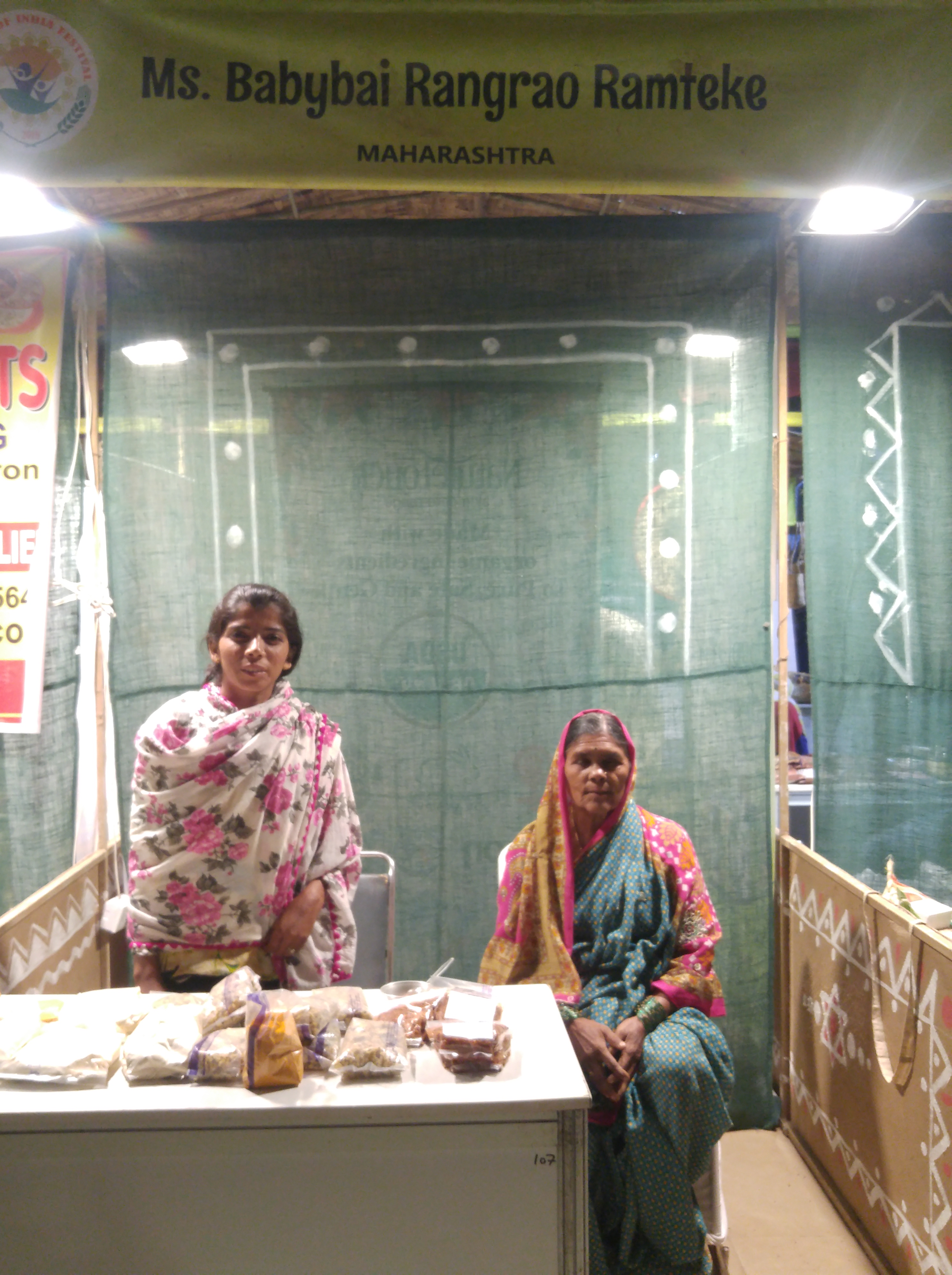
20181026_194212.jpgThe focus was mainly on grains with a push for millets and indigenous legumes. Spices and herbs was another category. I bought some Turmeric from a farmer family from Amaravati, maharashtra. It was heart warming to have a leisurely conversation in Marathi. Found at least four more stalls of people from the general area. One of the farmers informed that he visits a farmer’s market in Mumbai every week. They were savy in dealing with non-marathi people. Unlike the Maharashtrian farmers, the couple from Tamilnadu manning an organic seeds stall was new to the Delhi crowds and managed to communicate mostly through gestures. In spite of the handicap, they were doing brisk business. After all it is planting season in Delhi finally. Sahaja seeds from Karnataka also had a stall with a pair of women, one farmer and one from the NGO. They sell organic, open pollinated, public domain seeds.

The stall I remember the most however was Bare Necessities by Harsha Patil. I was pleasantly surprised to see the mooncup displayed among the other eco friendly products. In a country like India where talking about menstruation is a taboo it was quite exciting to see the product out there in the open. I hope it peeked interest and started conversations about menstrual health and environmental friendly sanitary products. 20181026_183738

Some other interesting stalls and organizations that I will explore further:
Beejom from NOIDA. They have a dung farm and were selling related products like dung pots, natural liquid fertilizer and pesticide, compost. They also had farm produce – fresh veggies, grains, and daals.


Dilli Diary

Road Trip in a TukTuk

Last time I was at Barafkhana for some gardening supplies, the vendor was surprised that I took the metro with a change at Kashmere Gate. According to her, it was like going out of the way to the city center to get back up to North Delhi. On my way back, she suggested, I take a cycle rikshaw to Ghantaghar and get another home from there. This prompted me to check the map when I realized that it was a straight drive down from our current residence.

Yesterday I finally found time to try the route on my way to the garden stores. It was quite easy and everybody was supremely helpful. The first TukTuk dropped me at the Gurudwara for Rs 10 and the driver pointed to the exact spot where I had the best chance of getting the next one for Rs 10. This one passed through neighbourhoods I would have not ventured through otherwise. We crossed a couple of roadside potters and an old gateway that supported three lanes of traffic through its three arches. I decided to come back to explore it later.

The biggest surprise however was the Ghantaghar Chawk itself. The TukTuk dropped me into a bustling bazar full of roadside vendors hawking colorful wares lined up in front of traditional Mithaiwalas (sweetmeat shops), dairy product shops, grocers, plasticware shops, and pickle shops. A few conversations with vendors and shoppers confirmed that it was more than busy that day because of KaravaChauth, a festival celebrated in West and North India. Women fast on the day for their husband’s long life and celebrate at night after looking at the crescent moon. I obviously decided to break my roadtrip and explore this fascinating place before I continued on to the garden stores. Here are some snapshots:

Baskets of Mathri at a Rajasthani Mithaiwala.
20181023_155913.jpgA woman getting one prepared for her daughter’s first KarvaChauth gave me a low down on other things that will go with it as a gift inclusing diamand jewelery for daughter, gold something for the son-in-law etc with a price tag of 1 lakh. The Mathris seemed like the cheapest but traditionally most important part of the gift. I was told a Sargi or a food and puja item basket which includes mathari is sent by the mother-in-law to the daughter-in-law. Not sure if this was the same.

Street vendors selling Puja items: Terracota pots painted with traditional motif and similar pot shapes made of sugar. Reminded me of Gudhi Padva, the Marathi new year, when we use garlands made of sugar.

Other Puja items and Henna cones:

Women dress up for the occassion with Henna on their hands, and Zari decorated saris or lehengas, at least in Bollywood movies which is the sole source of my knowlege for this occassion. Newspapers for a couple of weeks have been full of advertisements for specials on women’s spa services, makeup and garments.
Accessories and cosmetics for women: Bangles, wedding necklace, and makeup items.


Dilli Diary

Ramleela

After agonizing over which Ramleela to go to we selected one at the Red Fort. We started towards the pandal we could see as we were coming out of the station. The red fort is closed for the duration of the festivities. P1030213.JPG
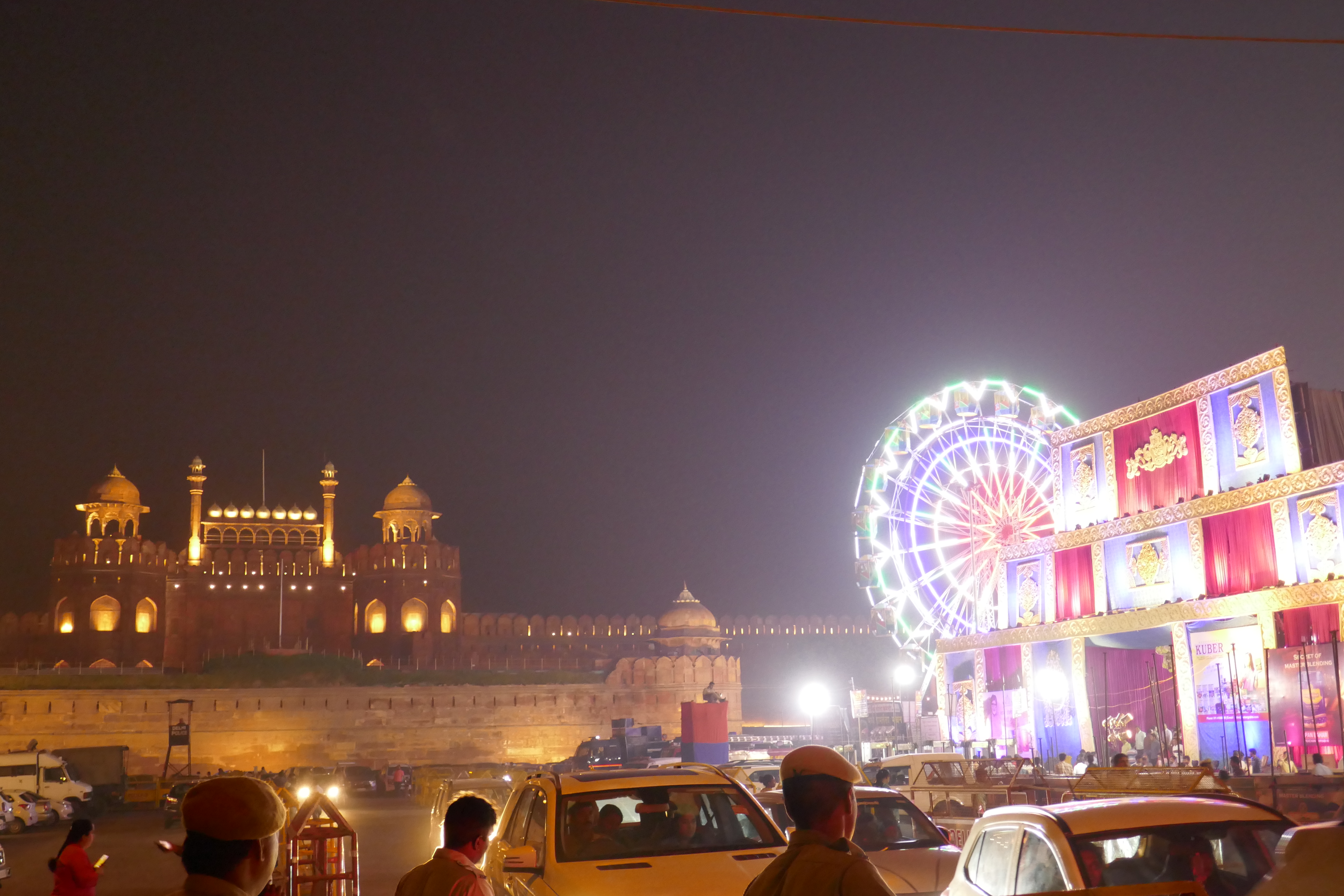
The first reaction when we entered was excitement like a child. There were joy rides including multiple ferris wheels; all the mela food items – buddhi ke baal (cotton candy), bhel and variety of chaats, barfacha gola (chusky/shaved ice) were right there with the other fun stuff like photo studios, stalls where you could win gifts when you throw a ring or shoot correctly at a target, kid’s toys, haunted house. Basically all the things you experienced in a mela as a child or saw in an Indian movie where the brothers get separated. LOL.

After taking in all that was on offer, we made a beeline to the Ramleela stage. On both sides of the stage there were empty pandals, some with lavish seating. As we realized later, these were for the special guests of people who paid for these spaces as a contribution to the Ramleela.

No crowds at this time so we decided to explore the huge food pandal in front of the stage. The stalls were beautifully decorated with the ingredients of dishes they were selling and the chefs and servers were dressed impecabelly. The pandal had much more of a royal feel than the food stalls we saw coming in.  We ended up trying three snacks – Mung chilla, Kulle, and paneer mava tikki. The green and mithi chatanis were nothing like I have had before. Thick and flavorful.

After PetPuja we decided to explore the rest of the mela beyond the stage. To our greatest surprise it was the LavKush Samiti’s mela right next door. The feel was much different than the New Dharmik Samiti mela we had just left behind. It was also bustling with people. The ramleela was going on the stage already.  No royal looking food stall here though it was full of the same kind of stalls and food items but with slightly less fanfare. Both the Samiti’s had put up digital screens as backdrops but the Lavkush also had huge screens further away from the stage that showed multiple storylines going on the stage. When we arrived Ram and Lakshman were walking in the forest probably after Sita’s abduction. The song narrated their dialogue. For a long time they kept walking slowly across the stage so we decided to go back to the New Dharmik to see what was going on there.

We sat for a long time waiting for some movement. The volunteer kids dressed in white and khakis arrived, had their food, took their places for crowd control and tied the remaining food in a bag next to their posts to the bamboo poles dividing the seating zones. After a short chat with them we realized that the performance will not start for another hour and will go on past midnight. The weather was beautiful, the air smelled of grass clippings, so we decided to settle down with our main course of dinner.

Throngs of crowds started arriving and we realized it must be time. Ram, Lakshman, Sita arrived in a chariot and went round the huge seating area. Then Bharat and Shatrughna arrived and did their rounds. The story moved faster. The background music was sophisticated and more importantly the acting was really good and believable. As the scenes unfolded on the stage, newer characters came out to make their rounds through the crowds.  We liked the imposing Ravan the most.

Ready to go home we reached the metro station and realized there was a third mela organized by the Shri Dharmik Samiti, next to the first one. We had missed it as we came out of the metro with our backs to their entrance. This one needed an Entry Pass. We were told this was the best one that we should not miss and some person at the door made sure that we got a pass. Visits to the three melas was a lesson in sociology and how the class differences play out. We realized that the placement matched exactly with the classes that gathered there Lavkush, New Dharmik, and Shri Dharmik – everybody going to the one that they felt most comfortable with. The look and feel was different; the security arrangements were different; some food items in Shri Dharmik weren’t available in others and some of the toys on offer showed the class divide as well. I wondered if the Shri Dharmik used the passes as a special effort to keep what they thought as the ‘rifraff’ out. It was quite an education about Delhi society.

Some interesting things we saw in Shri Dharmik Samiti’s mela:

Musings

Navaratri vs Durga Puja

The Navaratri vs DurgaPuja fights continue. I wrote about the meat shop closures in Gurgaon and Faridabad couple days back. That was Delhi NCR, so although ignorant, I can understand it somewhat.

Now hindutva groups are taking offence to a Bengali advertisement by Fortune foods that shows a woman planning for the 4 day feast including fish and meat. See Scrolls’s coverage here. According to Scroll the organization translated the lyrics in Hindi. From what I can see it is a completely wrong translation that adds the Navaratri ethos to a Durga Puja related video and creates a completely different story. I could not find that translation but on twitter found the @HinduJagrutiOrg congratulating themselves with followers commending them and the Hindu Ekta/unity.

Hindujagaran.org has a message about the advertisement on their site  “इस विज्ञापन में महिला को आदिशक्ति दुर्गामाता के रूप में दिखाया गया था आैर उसके हाथ में शस्त्रों की जगह विविध प्रकार के खाना बनाने के चम्मच दिखाएं गए थे । इस तरह मां दुर्गादेवी का मानवीकरण कर उसका अपमान किया गया था”

So the outrage here seems to be about humanizing the goddess. The problem however is that Bengalis do consider Durga as if she is a family member coming down to her Maayaka for the four days with her family and pamper her as if she is the daughter of the house. She is the mother and the daughter and a lekurvali as we would call her in Marathi. This is my understanding from interacting with Bengalis around me. This advertisement perfectly showcases the Bengali spirit during Pujo times. You can see that in the comments from Bengali people on the youtube video. It sounds somewhat like the liberties we take with Ganesh, our favourite deity. It is done out of love and sense of closeness. How can that be insulting?

Last year Javed Habib similarly had faced outrage for ‘using’ Durga in his print advertisements that show Durga coming to his saloon with her family. Here is the Indian Express coverage.  I am told that it is a tradition for Bengalis, in print media and cartoons, to showcase Durga with her family doing everyday tasks. The article at the end also shares some of the print ads that have appeared before. Habib is not insulting a Hindu goddess, he has depicted the Bengali spirit perfectly.

These episodes were pretty disturbing for me, much more than the meat shop closures. Both these advertisements were targeted at Bengali people. It wasn’t even in their North Indian backyard. The hindutva organizations in both these instances have gone looking for insult and excuse for outrage. Is this a pre-election ploy to get people riled up about things that don’t matter or do not even exist?

The people responding to the tweet are Marathi and Hindi. Marathi probably because ShivSena is part of the consortium of hindutva organizations. That scares me. I wonder about the future of my home state Maharasthra, the social activism hub of 19th century. It is unfortunate/alarming if this is what we are leaving behind for the next generation when the previous generations left us the legacy of Phule and Karve.

To improve your mood a bit after all this doomsday talk, here is one more Pujo song from Sawan Datta. Enjoy!

Musings

Your food, my food

I am pretty excited about pendal hopping for Durga Puja. I know it is not Kolkatta but I will take whatever I get as my first experience of Durga Puja in  Delhi – the dhak, dhunachi, the dance, the merrymaking, and most importantly the food. Started the planning already by joining a pre-Durga Puja guided walk (more about it here) and googling for lists of ‘do not to miss’ pendals and food items.

Although Bengali Durga Puja is about the goddess and coincides with the Navaratri celebrated in North India, it has a completely different ethos. Navaratri is about fasting while food, dressing up, and merrymaking are the integral part of Pujo. These are both Hindu people celebrating Hindu festival but the practices are completely different. During the pre-Durga Puja walk a north Indian couple of foodies were telling me about how difficult it is for them during pendal hopping as they see all this wonderful food but can’t touch it as they don’t eat non-veg (meat, seafood) during Navaratri. They were at the pre-Durga Puja walk so that they could eat what they would otherwise miss during the actual celebrations.

In the popular media however, there is utter ignorance about other communities living in such close proximity. Not just ignorance but belief that their version of the Navaratri is The Hindu version of what happens during the nine days.

A comment on article about ‘not to miss food items during Pujo’ ridicules the author for mentioning non-veg dishes. “How can you be stupid to add this during these days. Don’t you know people don’t eat non-veg during this time?” is the general tone in many places on the internet as Bengali people remind sommenters that for Bengalis the rules are different. The bhog for the goddess includes illish, the fish most favourite of the bongs.

On this background I read the news today that a consortium of 22 Hindu groups has threatened to force shut all meat shops in Gurugram (Gudgaon) during the festival of Navaratri. Shivsena, one of the member of the consortium, has gathered 125 members to coax or coerce meat shop owners to comply. First of all what is Shivsena doing in Gurgaon of all the places. It is a local organization from Maharashtra. Secondly, who gave them permission to decide what people should or should not eat during Navaratri.

I am not quite sure if this is being portrayed as a religious thing – Hindus vs other meat eating religions. It is wrong even then. However, it is worse as one way of being a Hindu is being touted as The way. How about look just a few miles away in Chittaranjan park, shops brimming with mutton and fish readying themselves for Durga Puja. Those are Hindus too. That is also a ‘traditional’ way to be a hindu.

This monolithic image of a Hindu being touted and enforced with threat of violence is the most dangerous thing about the right wing spread.  I always thought that acknowledging the different practices of Hindus makes them open to live with people of other religions peacefully and participate in their celebrations.  If we loose sight of the colourful diverse canvas of hindu practices and our ethos of celebrating each one, there is no hope left for harmony among religions.

Dilli Diary

Pujo Ascche

p10301291.jpgAs the weather gets better I am planning my walks to understand this city I call home now. Opened up the season with a pre-Durga Puja walk with Delhi By Foot yesterday.  My way of trying to get a hang of how to do pandal hopping during Durga Puja, supposedly the thing to do in Delhi in October.

The walk in CR park ended up being an insider’s look on the frenzy as Bengali’s get ready for the most important festival of the year. The bazars were overflowing with people shopping in the book fair; buying the special Pujo magazines; wandering through Pujo mela bursting at the sims with stalls of clothes, accesories, home goods; preparing for cultural programs, dance competitions, and last minute planning meetings.

The pandals are getting ready for the arrival of the goddess and her family.

The idols are getting ready at the Kumhor next to the Kali badi in CR Park. Some are being created in the pandals. The visit to the workshop where artisans were preparing the idols reminded me of our childhood visits to the Dhondphale workshop in Rastapeth before Ganesh festival. My father in a bid to avoid the fetival crowds used to take us to the workshop in lieu of the pandal hopping later.

The idol making is completely different in this case however and I am glad I could see behind the curtain work going on. Unlike the lone Ganesh, Durga Puja idols we saw were created as a family – Durga with her lion, flanked by Ganesh with the mouse, Kartikeya with his peacok, and the sisters Lakshmi and Saraswati. The whole family is created on a backdrop built with bamboo. The torso, limbs and body parts, unlike the ganesh murti are first created in hay and then finished with multiple applications of clay of various viscocity. Most of the idols were going to be dressed in actual cloth so only the visible parts were being painted. This was new and different as Ganesh idols come ready with the clothes and accessories created in clay and painted to show the fall of the cloth.

The idols in one of the CR park pandals are ready but still need color, clothing and accesories. The artisans from Kolkata have been working right here since August. When we visited the pandal they were creating paper mache decorations that depict the art forms of Bengal. Organizers urged us not to post photos and ruin the surprise. Looking forward to visit some of the pandals starting saptami to see the finished look.


Musings · Social Media, Technology & Education

Hindi Hain Hum: language skirmishes continue

I try to avoid commenting on language skirmishes on twitter but yesterday some statistics shared in a tweet war peaked my interest. It all started from a Kannadiga receiving entry-pass in Hindi which is unreadable for him. The expectation was that it should be in Kannada the local language or at least there could have been an option to select the language of the pass. The rebuttal was that Hindi is the majority language (41% speaker) and for practical purposes it should be accepted as The language.

There are multiple problems in that discourse. Firstly, the assumption that a nation needs one language, one identity to gather behind is not an indisputable fact. I have already discussed that here so I will skip that. The detail that pushed me down the rabit hole was the figure 41%.

I was quite surprised to see the original census data. This percentage quoted comes from the 2001 census. The numbers aggregate speakers of 49 languages including Hindi, excluding the category ‘Other’. This includes prominent and widely spoken languages like Bhojpuri, speakers of which are fighting to get a separate language status. One of the oft repeated complaint under #StopHindiImposition is how Hindi belt or the Central Government is silencing the voice of South Indians and Bengalis by forcing Hindi instead of local languages. I wonder if we are aware that we do the same as we paint a lively and diverse language landscape from Rajasthan to Bihar and Uttaranchal to madhyapradesh in a broad brush stroke of ‘the Hindi belt’.

The latest census data is from 2011. The percentage of Hindi speakers has increased over the decade to 44% but so has the number of languages combined under the heading Hindi.  To make sense of this data better I am trying to create a data visualization – a language map of what the Hindi belt looks like in its different hues. Please suggest any tools, code or any ideas you may have for map based visualization in the comments below.

The census data, the attached documents and summaries are a gold mine to understand the language landscape as well as the politics behind the data. Stay tuned to see more historical data, comparisons over the year and the socio-economical, political variables that decide the status and spread of a language.