Category: Musings
My history, Your history
Everybody at the information desk was happy to talk and give more information. The most interesting conversation of the evening however was with an older lady. We were talking about Myanmar, a word she could not place. I described it as Burma, the country to the east of Bangladesh. We had a lot more confusing back and forth as she thought it was next to Pakistan and I could not understand how she could miss the whole big chunk of India in the middle.
After some back and forth we realized that the visual of the map in her head was fine, facts from history was the problem. She was in school when Bangladesh was still part of Pakistan and was not aware of its formation in 1971. Part of history that I took for granted as part of world history was not an obvious nugget of information for her.
Some of it is also about geography and how we see things as near-far, relevant-irrelevant, or in size big-small based on where we currently live. More on perception of geography and how we see maps some other time.
Providence Firsts
One very important event was burning of the Gaspee as the event leading to the declaration of independence rather than the Boston tea party that I learned about in school (in India) learning about American Independence.
The Gaspee Day committee has been arranging various events to acquaint the public with an event that is as much a part of the national heritage as Paul Revere’s ride and the Battles of Lexington and Concord. The Burning of the Gaspee was the first link in the chain of events that led directly to the Declaration of Independence.
A short description from the Gaspee Day committee website:
“In June of 1772 brave colonists from Rhode Island burned the British revenue schooner, HMS Gaspee, during what has become recognized as the first bloodshed of the American Revolution.
For the past 49 years the village of Pawtuxet, RI has commemorated this act with our annual Gaspee Days Celebration. “
The other first (or is it a second) was the Providence art club. The club was started in 1880s by 10 men and 6 women who wanted to create a permanent place for artists to get together, work, have an exhibition gallery and where connoisseurs can go to buy art.
It was fascinating to visit studios that some of the artists opened up for the gallery night. Most interesting was talking with Anthony Tomacelli. Listening to him explain his process of painting and how different colors interact with each other changed how I look at art and the different hues of blue, orange, and violet.
The Little Pictures Show and Sale that the Providence Art Club hosts every year is also a first. The exhibition starts in November and goes on till Decemerb 23. The art has to be smaller than 16 X 16 and priced at $250 or less. I was told that this is an opportunity to buy an original piece of art by some well known area artists cheaper. This year is the 109th year of this exhibition.
There were other firsts and seconds (Providence seems to have a lot of seconds) mentioned by tour participants. I am planning to explore the history of the area more through its buildings and museums. Will post more as I explore more.
The tale of two Indias
Lot to digest, for example – Choosing two girls from these specific circumstances and not others to contrast, especially since the struggle between tradition and modernity was a thread throughout. The visual of the girl sitting at the beach facing the Mumbai skyline juxtaposed with silhouettes of mountains and temple spires on the left shows this thread of presentation to come. As the documentary progressed, it was very interesting to see assumptions made about what is ‘modern’ when it comes to women in India. What is considered freeing, enabling and how it is shown as one or the other rather than a complex mix in both the paths these girls chose.
I want to go back and watch it again to see how certain views, values, visuals were highlighted or played down.
Circles in my life
My efforts at creating google circles was supremely unsuccessful (mostly because of google+ not working for me) so has been making groups on Facebook to selectively share stuff. Some of what I share is geographically related. For example the Africans in India exhibition I recently shared is accessible only to people living in NYC, so are various events at TC, Columbia University or other neighboring institutions. Some of it is more personal, like cute photos of my friends visiting us and celebrating Christmas, opening presents that are not necessarily unworthy to be shared with acquaintances but not particularly necessary to broadcast either.
I created a page on Facebook for my extended family and it has picked up really well. However, there is no way I can include some of the activities of the family I acquired here in US over time like my friend Marcelle and her two boys, my roommate Selen. After my parent’s visit to US the task has become much more difficult. Not only do I have two versions of family but some of the members of these two versions know each other well and I would like to share ‘stuff’ that both will enjoy.
The other side of it is to think about what will people I am related to want me to share. I had not thought about it before. Now that I think about it, I enjoy, actively read everything my sisters, friends in India post in spite of it being absolutely not related to me due to it being locally relevant geographically or local to some conversation I am not party to. Stalking my sisters and friends gives me a feeling that I am part of their lives more than possible given the distance (much of it in time zones).
This long ‘thinking out loud’ is not about the functionality so much but my inability or I think more of my aversion to define my various relations as to where they fit on the plane of relatedness.
Remembering the dearly departed
Around the same time, after death of activist Aaron Swartz, there is an ongoing conversation on AIR about a pdf memorial for him. This subject also stuck in my mind because just a week back there was a discussion about online bereavement, memorials, and presence after death and related research on the AIR listserve.
I had not thought of my online presence as my legacy or memorabilia that my family might want as a keepsake. I most definitely had not thought about the legalities concerned and the need to add instructions for handling my various online presence as part of my will.
One reason for not thinking about it is that the thought of death and related practicalities has not been the foremost in my mind right now. Secondly, the idea of keepsakes from and memorials of dearly departed is not something that is culturally obvious to me. My friend showed me a watch that was given to her by her aunt as a keepsake after her death. I have read in novels and seen in movies and in TV series that people keep items of their departed relatives and friends as keepsakes. I have seen many deaths as I grew up but do not remember any practice of keepsakes. There is no custom of burial so no tombstone to visit, the ashes are thrown in the river so no keepsake urns on the mantle piece.
I wonder if it is the difference between the attitude towards death – the idea of moving on after a death vs. keeping memory of a person alive after death. Then I think of all the rituals we have for dead ancestors. The yearly food donation my parents make for my grandparents on their death anniversary. May be it is just a different way to remember.
How safe do we feel in our city?
Sharing food
I was writing about exploring different cultures through food in my blog post Culinary Adventures, and realized that I have never posted any photos of our food excursions or of the potlucks. So here they are. I will add photos as I find them.
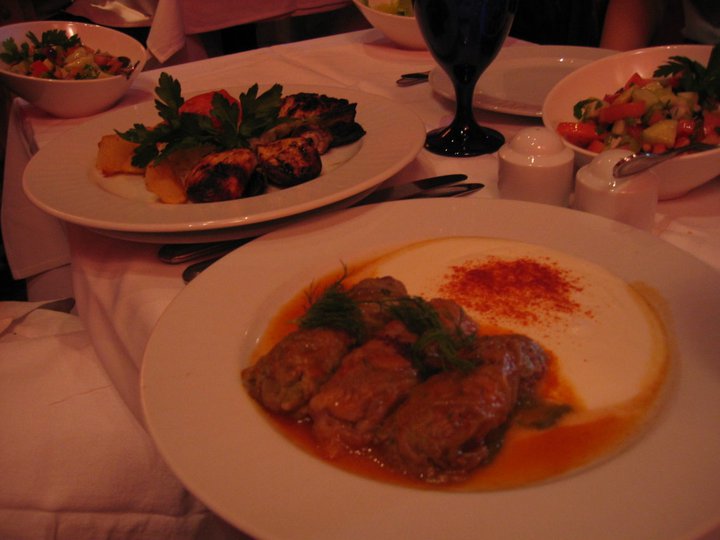
Lunch in a Turkish restaurant with Selen and her friend, Tina and Weinjing. Followed by turkish coffee and reading of fortunes 😉
Culinary Adventures
During my first couple of years in New York, we used to hold potlucks where everybody brought one traditional dish from their country, region or family tradition. We also planned food excursions where a group of us used to go experience a particular type of cuisine. All of it on student budget. I have been fortunate in finding a multicultural and multinational group of friends to share my food passion with. From my South African friend’s pot of curry with star anise to my Chinese friends taking me to their favorite dumpling place, my Turkish friend introducing me to the dolma, baklava, halva, and grape leaves, Korean friend making a special dish of dduk bok ki and the list can go on.
The funny part is that the dduk bok ki and the potluck party around it was planned because one of our American friend craved for it. She was the one who actually introduced me to this fantastic Korean food. Similarly my Turkish friend introduced me to Sushi and sashimi. We are truly an international bunch here with transnational experiences.
I love exploring people and cultures through food as everything is connected to food. Food opens up conversations about life experiences. Once I took my South African friend to an Indian Grocery store. She saw Maltova there and was super excited. She used to eat Maltova as a kid and her kids like it too. So I learnt the stories of her childhood and her kids growing up in SA. Sharing of Shevayachi Kheer is another such instance. She knows it as Buba (sp?). Something her Muslim neighbors and her mother’s Muslim friends shared with them on Eid. And then we talk about the friendships between various ethnic and religious groups, traditions that were borrowed and shared, the chat coming back full circle to the spices and culinary influences they have on each other and to her famous curry with star anise.
I went for a potluck dinner last night with a couple of friends welcoming parents of another friend. We had a nice spread, Marcel’s curry, Amina’s okra, cauliflower rassa and a medley Aisha brought. The dinner was topped with Amina’s famous fruit cream and wonderful conversation. Everyone talking about their culture, customs and stories of their life. It was nourishment for the soul. A parallel session of mendi (henna) designs helped as well to un-clutter the mind.
We haven’t been doing this as frequently as we should. Everybody busy with their research, life and all the stresses that are part of a doctoral student’s life. May be that is what I need. Another culinary adventure. Table full of food from all over the world, conversations as varied as the food. Perfect therapy for weary soul.
Bell Bajao Abhiyan
http://www.mediathatmattersfest.org/festival/9/911.swfThis video was shared in our Media, Culture and Education class. I was pretty impressed by the video and also by the fact that it was distributed by Govt of India (Ministry of Women and Child Development). The video is crisp with strong visuals. The ball bouncing in the kid’s hand and the image and sound of the bell are two very powerful images.
In the class, it was interesting to hear comments from an international crowd. For me the most important aspect was adolescents having power to intervene. Here are some comments from the class that stood out: would have liked to see girls in the mix; punk kids (refering to the galli cricket gang) taking social action was a powerful message, opening and closing of the doors seemed like passing of days and that the kids would always be there.
I personally thought that the same film would not have worked with girls. Galli cricket is a phenomenon. In this case with a Chaul setting, in lower middle class Mumbai. I assumed that in a different setting girls/women will have a role. I was reading more about the film maker Mallika Dutt and stumbled upon the website for the Bell Bajao Abhiyan (Ring the bell campaign). There are two more videos. Both featuring men (not young adults) taking similar action, ringing the bell. The website says the campaign is “asking men and boys to bring domestic violence to a halt”. I have to read more to see why they are focusing on men. It was intersting though that I never saw the absence of girls in the video till it was pointed out.