Musings

Remembering the dearly departed

I stumbled upon an article in the weekend edition of the Wall Street Journal (Jan 4,5 2013) titled Life and Death Online: Who Controls the digital legacy. It is a story of a teenager who died and her parents were fighting to get access to her online presence like emails, social network site accounts and so on.

Around the same time, after death of activist Aaron Swartz, there is an ongoing conversation on AIR about a pdf memorial for him. This subject also stuck in my mind because just a week back there was a discussion about online bereavement, memorials, and presence after death and related research on the AIR listserve.

I had not thought of my online presence as my legacy or memorabilia that my family might want as a keepsake. I most definitely had not thought about the legalities concerned and the need to add instructions for handling my various online presence as part of my will.

One reason for not thinking about it is that the thought of death and related practicalities has not been the foremost in my mind right now. Secondly, the idea of keepsakes from and memorials of dearly departed is not something that is culturally obvious to me. My friend showed me a watch that was given to her by her aunt as a keepsake after her death. I have read in novels and seen in movies and in TV series that people keep items of their departed relatives and friends as keepsakes. I have seen many deaths as I grew up but do not remember any practice of keepsakes. There is no custom of burial so no tombstone to visit, the ashes are thrown in the river so no keepsake urns on the mantle piece.

I wonder if it is the difference between the attitude towards death – the idea of moving on after a death vs. keeping memory of a person alive after death. Then I think of all the rituals we have for dead ancestors. The yearly food donation my parents make for my grandparents on their death anniversary. May be it is just a different way to remember.  

India Outside India

India portrayed in Indian restaurants

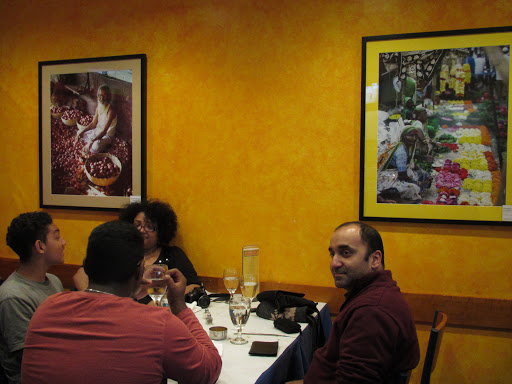
We were visiting Rasoi, one of the Indian restaurants in Providence, with our friends from South Africa (via NYC). We have been frequenting Rasoi for their Sunday brunch. They have the best Indian food I have tasted in a while. They also have huge photos from India as decoration on their walls. I was pleasantly surprised and excited this time to see photos that seemed like they were taken in Maharashtra. On closer inspection I found a note about the exact location. Mandai!!! Who knew I would sit next to photos of women making garlands and a man selling onions taken in Mandai of all the places. For the people who do not get the reference, Mandai in Pune, my home town, is a marketplace bang in the middle of the old city. Well that description doesn’t do justice to what Mandai and the whole experience of going to Mandai is all about.

These photos reminded me of other surprising visuals used for decorations in other restaurants.

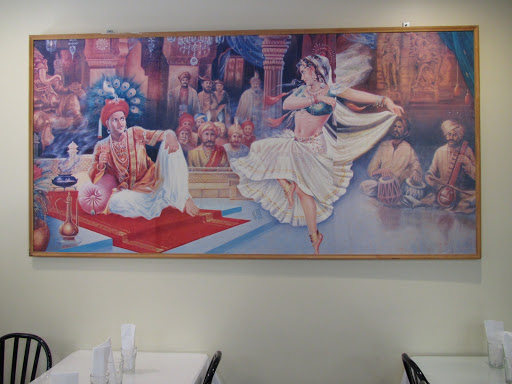
The following two paintings are from a restaurant in Niagara falls, US. The paintings portray the Peshvas based in Pune, one of the important players on the political scene locally in Maharashtra in 18th century and possibly on the subcontinent during the reign of Bajirav Peshva in the first half of the 18th century. The romantic story of Bajirav and Mastani the courtesan is well know in Maharashtra. The other painting was that of the Shanivarvada, the fortified palace of the Peshvas in Pune. You can see only a part of it behind me in the second photo. I was quite surprised to see the Peshvas as visual representation of Indian. Even in India, many of the people outside Maharashtra do not know of the Maratha and Peshva history as the history books focus more on the dynasties based in Delhi and the Rajputs of the North western region.

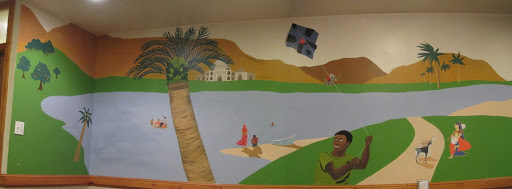
The other painting that caught my eye and made me chuckle is in another restaurant in Providence – Not Just Snacks. The painting has all the symbols of ‘exotic India’ bringing together different pieces of place and time in an unusual collage – elephant, peacock, Tajmahal, coconut, palm, and mango trees,  a boy flying kite, a singer (Meerabai??) with a string instrument who is from some bygone era, and people who look like they are from northern India on the banks of a river (Ganga??) Oh and I forgot the deer mesmerized by the song Meerabai is playing/singing.  Mountains behind the Tajmahal, the river plains in the middle and I am assuming desert behind Meerabai.

Musings

How safe do we feel in our city?

The first public place I went to the first day I reached Pune this time I visited India was a restaurant my sisters and cousins took me to. My sister was stopped and the boot of her car searched. I felt a bit frazzled. Where were they taking me? Is this some important building housing foreign nationals, bureaucrats, ambassadors or may be big shot Bollywood stars? Is there some kind of alert? No. it is just a terrace restaurant my sister told me. It seemed like she had experienced this before and thought it was perfectly normal.
The next shock was visit to the dentist. The dentist’s office is on the top floor of a hospital. There were metal detectors and purses and bags were being searched. I felt really unsettled. My sister again reassured that it is a routine procedure in all hospitals now. There was no red alert or anything to worry about. Everybody in the line continued like it was an everyday thing. I seemed to be the only one who was shocked, confused, pained.
The third time I went through metal detectors in another hospital building, it did not shock me but it still did not feel normal part of life. The security in terms of metal detectors, bag searching, checking vehicles etc. started at various public places like hospitals, restaurants, business centers after the Feb 2010 bomb blast at German bakery.  I had visited Pune before that in 2009 making this development shocking and painful experience.
Pune is an important city from the military point of view as it is the headquarters of the southern command. It is also a potential target for terrorist attack because of the National Chemical laboratory (NCL), National Defense Academy (NDA),  – a military training center, Armament Research Development Establishment (ARDE), High Energy Materials Research Laboratory (HEMRL) and the list goes on. I lived in close proximity of the later two before moving to NYC but it never felt unsafe.
Now that I am back in NYC and thinking about it, I remember the paramilitary police and military presence in Penn station. People loaded with assault rifles and ammunition in their military fatigues. Interestingly their presence neither makes me anxious nor does it make me feel secure. For me they are just kind of part of the picture like the eateries, people running here and there, announcements, signs for trains arriving and so on.   
I have read multiple times the warning signs in subway stations that backpacks can be randomly searched. Initially when I glanced at the sign I immediately thought about the contents of my back pack and if I had packed it well enough that they can do a cursory search and did not have to take everything out. I also thought about the people who they might stop and wondered what they might see that made them stop the person. Did I have characteristics that will make them stop me? As the city became my own, and I did not feel like an outsider, I stopped thinking about these signs as well.
I don’t feel unsafe living in NYC. Though logically I should if I make a list of reasons it could be a terrorist target and also by the presence of the military and the searching that tells me that there is a possibility. But I don’t feel unsafe. The possibility of an attack does not enter my day-to-day thinking. I don’t think twice before entering a subway. I wonder if visitors to NYC feel differently.
This chain of thought reminds me of a conversation way back in 2004 when I was visiting a client in Chicago. I lived in India at that time. He asked me how I felt living in India always feeling unsafe thinking about the nuclear capability of India and Pakistan and their strained relationship. What? I had never thought of it that way before he mentioned it. I did not feel unsafe, not for a single moment. We did not live in constant fear of the next attack or nuclear fallout. Everyday life was as normal as it could be even though perception of an outsider was far from it. People even in places plagued with terrorist threats and violence do get on with their lives and do have everyday lives as normal as possible in their circumstance. Just like it was normal life for my sisters I guess when I visited them this time, though not for me. Just like life is normal to me here in NYC! 
Musings

Sharing food

I was writing about exploring different cultures through food in my blog post Culinary Adventures, and realized that I have never posted any photos of our food excursions or of the potlucks. So here they are. I will add photos as I find them.

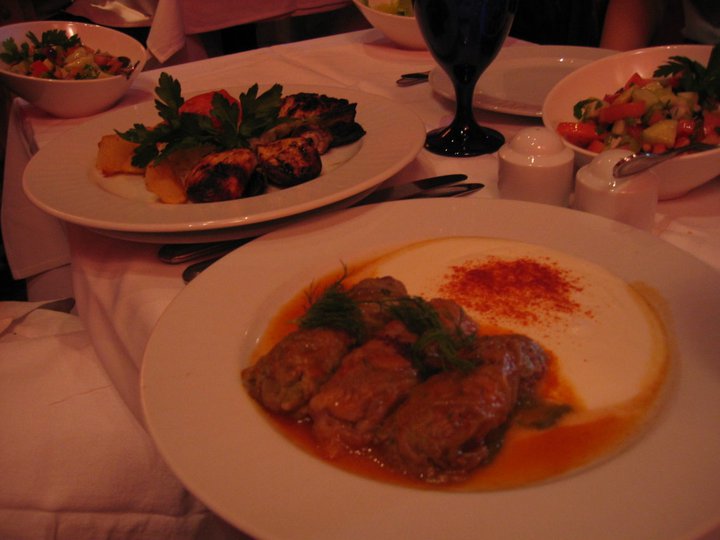
Lunch in a Turkish restaurant with Selen and her friend, Tina and Weinjing. Followed by turkish coffee and reading of fortunes 😉

Housewarming party at our home. Misal and Marcelle’s Curry
India Outside India

Swastika again …

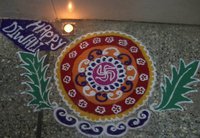
It was Diwali week last week. A lot of people from home updated their facebook profile photos with images related to their Diwali celebrations. One of it was of a rangoli in the doorway with swastika in the center. I was wondering what people outside of India (Western countries) will associate it with.
I wrote a couple of blog posts some time (years?) back about Indian Swastika and Hitler’s Hakenkreuz, after the swastika controversy in TC. I talked with people wherever I went, about the Indian Swastika and the meaning of the word itself (Swasti = wellbeing). I tried to unpack my feelings about how I feel when it is misrepresented as a symbol of hate. Talked with the office of diversity in Teachers College and told them I will help with the lecture they were planning about symbols and their meanings in different cultures, in the hope that I can talk about the difference between the Indian Swastika, the meaning of the word and how it differs from Hitler’s symbol of SS.

Nothing much has changed after that. In the Diwali packet I got a sticker imitating Rangoli design. At both ends of the colorful strip are two swastikas. Rangoli designs are drawn for various reasons. The ones in the doorway like my sister sent, are to bring happiness, prosperity and feeling of festivity. The ausipicious symbol of a swastika, the name of which itself means ‘wellbeing’ is generally a given in such drawings. I obviously would not be putting it in my doorway in US for the fear that people will label me fascist, anti-Semite. I don’t know how I feel about this. I am not a big fan of Rangoli stickers (I rather draw whatever I feel like everyday) but the matter of am I free to draw or stick a swastika on my door (in the context of a rangoli) without being labeled anti-Semite still remains.

As I said nothing has changed.

India Outside India

Obama’s visit to India: Images perceived and portrayed

Some points that came up in the media coverage about perceived and redefined image of India

– Obama rejects view of India as “land of call centers”

– The United States sees Asia, especially India, as the market of the future

– India the land of cold-start (the Loch Ness monster that most of the Indians don’t know they have)

– India the victim of 2008 Mumbai attacks. (Just so that US can proclaim ‘India and US were united against terrorism’)

– On the other hand it is a giant ogling Pakistan on which US needs to put pressure so as to placate Pakistan and get its support in the ‘war against terrorism’

Musings

Culinary Adventures

I have been watching Anthony Bordain on Netflix, off and on this year. It is nice to experience various regions through his culinary adventures. I also like and very much appreciate the idea of knowing the culture through its food.

During my first couple of years in New York, we used to hold potlucks where everybody brought one traditional dish from their country, region or family tradition. We also planned food excursions where a group of us used to go experience a particular type of cuisine. All of it on student budget. I have been fortunate in finding a multicultural and multinational group of friends to share my food passion with.  From my South African friend’s pot of curry with star anise to my Chinese friends taking me to their favorite dumpling place, my Turkish friend introducing me to the dolma, baklava, halva, and  grape leaves,  Korean friend making a special dish of dduk bok ki and the list can go on.

The funny part is that the dduk bok ki and the potluck party around it was planned because one of our American friend craved for it. She was the one who actually introduced me to this fantastic Korean food. Similarly my Turkish friend introduced me to Sushi and sashimi. We are truly an international bunch here with transnational experiences. 

I love exploring people and cultures through food as everything is connected to food. Food opens up conversations about life experiences. Once I took my South African friend to an Indian Grocery store. She saw Maltova there and was super excited. She used to eat Maltova as a kid and her kids like it too. So I learnt the stories of her childhood and her kids growing up in SA. Sharing of Shevayachi Kheer is another such instance. She knows it as Buba (sp?). Something her Muslim neighbors and her mother’s Muslim friends shared with them on Eid. And then we talk about the friendships between various ethnic and religious groups, traditions that were borrowed and shared, the chat coming back full circle to the spices and culinary influences they have on each other and to her famous curry with star anise.

I went for a potluck dinner last night with a couple of friends welcoming parents of another friend.  We had a nice spread, Marcel’s curry, Amina’s okra, cauliflower rassa and a medley Aisha brought. The dinner was topped with Amina’s famous fruit cream and wonderful conversation. Everyone talking about their culture, customs and stories of their life.  It was nourishment for the soul. A parallel session of mendi (henna) designs helped as well to un-clutter the mind.

We haven’t been doing this as frequently as we should. Everybody busy with their research, life and all the stresses that are part of a doctoral student’s life. May be that is what I need. Another culinary adventure. Table full of food from all over the world, conversations as varied as the food.  Perfect therapy for weary soul.

Uncategorized

Selctive media hype of terrorism

I was pretty surprised to see the news of the Pune blast on the homepage of NY times yesterday. The article claimed that these are the first major attacks after Mumbai attacks in 2008. I wonder what makes attacks major or warrants attention in western media. Nobody seems to be bothered by attacks in the north east. Is it because they did not involve foreigners or there was no proximity of any shabad house? Are the lives of Indians and attacks on their religious places inconsequential?

Today the article has added this sentence “Any sign of Pakistani attack would worsen relations between the two nuclear rivals and further destabilize a region overshadowed by war in Afganistan.” Now-a-days, the ‘nuclear rivals’ has become a necessary phrase whenever the US media talks about India or Pakistan. It is amazing how none of the other nations with nuclear warheads are ever mentioned in this manner when a conflict arises on their land or of their making. Why this obsession of again and again mentioning the n word? Is this the age old strategy of a media hype followed by a US intervention I am seeing in making?

I also wonder how people/media conveniently forget to mention that US which at present is responsible and actively involved in military conflict in at least two contries itself has nuclear warheads.

PS: Sakal, a local newspaper in the state of Maharashtra reported that Chairman of the Joint Chief of Staff Mike Mullen said that countries of the world should intervene to smooth relations between India and Pakistan. I know there must be something lost in translation from English to Marathi and then to English. But you can’t deny that it fuels my fear about US intervention. I am trying to find the original quote in English but haven’t found it yet.