Musings

Bell Bajao Abhiyan

http://www.mediathatmattersfest.org/festival/9/911.swfThis video was shared in our Media, Culture and Education class. I was pretty impressed by the video and also by the fact that it was distributed by Govt of India (Ministry of Women and Child Development). The video is crisp with strong visuals. The ball bouncing in the kid’s hand and the image and sound of the bell are two very powerful images.

In the class, it was interesting to hear comments from an international crowd. For me the most important aspect was adolescents having power to intervene. Here are some comments from the class that stood out: would have liked to see girls in the mix; punk kids (refering to the galli cricket gang) taking social action was a powerful message, opening and closing of the doors seemed like passing of days and that the kids would always be there.

I personally thought that the same film would not have worked with girls. Galli cricket is a phenomenon. In this case with a Chaul setting, in lower middle class Mumbai. I assumed that in a different setting girls/women will have a role. I was reading more about the film maker Mallika Dutt and stumbled upon the website for the Bell Bajao Abhiyan (Ring the bell campaign). There are two more videos. Both featuring men (not young adults) taking similar action, ringing the bell. The website says the campaign is “asking men and boys to bring domestic violence to a halt”. I have to read more to see why they are focusing on men. It was intersting though that I never saw the absence of girls in the video till it was pointed out.

India Outside India

Chai tea, Masala chai and the real Indian tea

For the longest time I felt that it was my duty to educate Americans about the wrong nomenclature for the things they were eating under the name of Indian. Curry and Chai tea are two of my pet peeves. I have told numerous people numerous times (even when they didn’t care) that there is nothing called ‘curry’ in Indian cuisine, the way it is understood by Americans, Europeans and may be the rest of the world. I also started writing a blog post about it sometime back. I should publish it one of these days.

‘Chai tea’ was an irritation for two reasons – firstly, Chai tea is like saying ‘tea tea’. Chai means tea. It is hardly an adjective for tea. Secondly, I thought the spices they added in the name of Indian chai was just wrong. Just because we use spices like pepper, cinnamon, and cloves in Indian cuisine doesn’t mean we would add it in the spiced tea.

Cafe Fresh near Columbia serves a version of this ‘Chai tea’. The only relief is that the menu lists it as ‘Masala Chai’ (spiced tea). I was so excited to read the words ‘Masala Chai’ that I started frequenting the place for a cup of chai. Funnily, I have taken to the various versions of spiced tea sold by cafes like Starbucks and Cafe Fresh as well as those sold as teabags. Even though I like these spicy versions, I have always maintained that they are not real Indian tea because of the pepper in it.

So the other day when Shraddha and I were exchanging recipes and the secrets for the fresh home specific masalas, I was shocked to hear her version of the masala for chai. The masala in her house is made of Pepper, dried ginger powder and other spices. I asked her twice if that was her own recipe and she insisted that it was a traditional recipe. So all these years when I thought it was stupid of westerners to add pepper in the Chai, seems like they were more knowledgeable about some of the Indian customs than I was.

The tea bags with black or green tea and powdered or whole spices steeped in hot water still is nowhere close to the Masala chai made in any corner of India, but I have to regrettably take back my ill feelings about pepper in tea.

I still feel the need to introduce people to the chai (simple tea), and Masala chai we make at home. Tea powder/granules (not leaves) boiled till it is strong and dark. Fresh ginger and cardamom added while boiling for warmth on a rainy day. Generous milk added to soften the taste. A couple of my friends have got hooked to it. But I remember to add that it is my /our (Maharashtrian?? Puneri??) version of the tea, rather than extrapolating my experience as an average Indian experience.

India Outside India

Gandhi in NY: Peace, Social Activist, and World Leader

The first time I came across a mention of Mahatma Gandhi and a visual was in the sculpture garden of Cathedral of Saint John the Divine in the Fall of 2005. The sculptures were created by school children. I was actually pleasantly surprised. It (the surprised reaction) might have been because of the stereotype about Americans who have no general knowledge and no interest in the history, politics and happenings in the rest of the world. I try not to have such generalized notions of people. But this one is hard to get rid of. It also came from a feeling (at that time) of being culturally invisible. I was equally surprised for the same reason when I saw a picture of Indira Gandhi on a book cover about Women leaders in the classroom library of a Harlem school.

Anyway, continuing about Gandhi….I was so surprised that I decided to come back to take a photo, almost to prove to myself that ‘these people know about our Gandhi’. hahaha.

This photo of the sculpture was recently taken when I visited the sculpture garden again with my sister. (She was not suitably surprised to see Gandhi etched in a Cathedral garden. What a disappointment.) The sculpture is created by a school aged kid. It is a message of peace from Mahatma Gandhi.

In the same week we came across the sculpture of Mahatma Gandhi tucked away in a corner of Union square park. Wikipedia says that the newer addition of Gandhi’s sculpture in 1986 was to mark Union Square’s history of social activism.

The statue is quite well made. You can see the detail of his watch tucked in his Dhoti. Though I was quite disappointed to see him tucked in a corner like that.

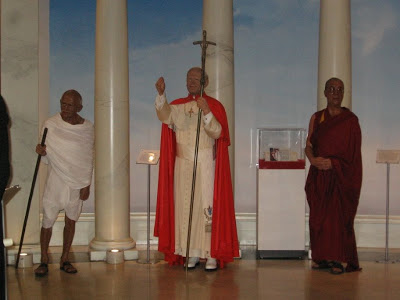
The following photo is from Madam Tussad’s on 42nd street. I thought the placement was very interesting – social leader, religious leader, spiritual leader.

India Outside India

Indian in US TV series

CSI – NY’s latest episode showed the festival of colors – holi being celebrated somewhere in Queens. I captured a couple of stills. As you can see the girls dancing are wearing a belly dancing costume. Is that a CSI version of Indian? CSI now-a-days is overly dramatizing scenes towards phony anyways.

Here is another one from the same scene. My first reaction was that this is another example of the ‘exotic east’ syndrome. But then again this might be the expression of Indian by the community in queens that I am discarding as not authentic enough. Me being the ‘real’ Indian and all. πŸ˜‰

Musings

My brush with emergency services in NYC

One fine day instead of going to my class in the afternoon I decided to go home. I was feeling very weak. I walked as fast as I could like a true NewYorker. If only I can reach home in time and lie down, I will be fine, I kept telling myself. The train took forever to come. When it reached 157th street station, it stopped and people were asked to vacate the train. There was an emergency in the previous train so the trains behind were all stuck too. By this time I was feeling pretty sick and couldn’t get up and leave. A lady asked me if I was feeling ok, and called some train personnel. He called 911.

It felt like it was forever before the FDNY guys came down. The first thing they did was whip out a form and start asking questions … demographic questions not medical ones. If I was well enough to answer such questions would I need the emergency service in the first place?

Suddenly they decided to take me out to the ambulance, probably because the train needed to move. At last, I thought, they are going to take me to the hospital and I might not die after all. The ambulance was parked just outside the station and it remained there for next 10-15 minutes. The question answer session resumed. I never realized how long my first and last name are before that day. Believe me it is beyond frustrating to talk when you are fainting, then to repeat the name because your’s is an Indian name and worse … one of the most difficult last name in India and one of the longest Indian first name. I gave them my wallet that had the college id card hoping it would satisfy basic questions like name, affiliation, insurance info etc. I then gave them my phone with my boss’s phone number on it. Hoping that they would ask him the questions and I could continue fainting in peace.

When my boss picked up the phone, the FDNY guy asked, ‘is this person your employee?’. John, being a good boss he is thought it was an information mining call and refused to say anything unless told why they needed the information. The FDNY guys did not tell them it was an emergency, probably in some convoluted way an effort not to invade my privacy.

All this time the second FDNY guy was trying to put an oxygen mask on my face. The mask didn’t work and it made me nautious so I was trying to remove it. This was going on parallely to the Q&A and fainting. I startd to question why we were still parked and not moving towards the hospital. The answer was totally baffling. The FDNY guy who was filing out the questionaire was the person who would drive the ambulance so unless I ‘co-operated’ I wasn’t going anywhere.

By this time, the second person in the ambulance, the one with the oxygen mask, started interjecting every few minutes, saying “I can’t get her pulse. hurry.” It is a miracle I survived those 15 minutes in the ambulance in spite of his constant reminder that I might be dying.

Add a third person in the mix now. The person from the MTNY. He came with his own questionaire and started asking me the same questions. They had to cover their behinds too since it happened while I was travelling in their train. I had to answer the same questions all over again. I guess the FDNY couldn’t share that information for fear of breaching confidentiality. πŸ˜‰

Finally we reached the hospital….. ER hallway more like it. Somebody put a pulse monitor on my finger. I was relieved that somebody was monitoring me even if I was in the hallway. Nothing happened for a long time and then somebody came and ‘borrowed’ the pulse monitor. Never came back.
After lying down in the hallway for a long time I automatically started feeling better. (I was amazed at my capacity to survive in the face of adversity πŸ˜‰ ) But now ER doctor wouldn’t let me go. She needed to check if I had internal bleeding. Another long wait, in a room this time, after which I left for home at 10 pm with an unreadable pink paper and without any diagnosis.
After 15 months and 3 hefty medical bills I still don’t know what happened that evening and why I am still alive πŸ™‚
Though the experience was traumatic, the whole story seems like a funny episode in a comedy movie script. Anybody wants the movie rights?

Musings · Social Media, Technology & Education

What does Devayani need

My friend Gus posted this on Facebook:

Google “[your first name] needs” and share the first 10 results (that are unique and make sense). Tag the person who tagged you, and pass it on…
Although I am not too much into the chain mail kind of thing, Gus is interested in google searches and this intrigued me so I did it:

It seems I don’t ‘need’ much. These are the only links that came up:
1. Then Sukra said: “O Kacha, because Devayani needs you I will today impart to you my knowledge. Come back into life as my son; and, possessing my knowledge, …

2. Because of her flat feet and lighter body weight, Devayani needs a flexible, soft shoe with lots of stability. …

If I type only ‘need’ instead of ‘needs’ 3 links tell me
‘Devayani need not grieve…’
lol

It is a reference to the same mythological story in #1 above where Devayani needs Kacha.

This Devayani doesn’t seem to leave me alone even in google searches. My grandfather named me after this mythological figure because she was very intelligent (and he predicted that I was going to be veeery intelligent). My mom was quite worried after the naming as the mythological Devayani was also short tempered. To be or not to be (Devayani) has always been a question!

Musings

Houses and Homes

I like living in New York, especially in comparison to Storrs. The obvious reasons you might think of are that I like fast paced life and the infinite possibilities offered by a metro like New York. Those reasons are not entirely off the mark but the most attractive aspect of living in New York for me is that the building I live in is made of bricks.

The worst thing about living in Storrs is the wooden houses. In my mind it has a sense of impermanence. A wooden house does not seem like a secure structure I can call home. It has nothing to do with fire hazard. My Indian mind does not think about risk to life so much.

A house made of wood for me is either a cabin in the woods you would visit once in a while or a temporary structure created till the actual home, office is built. More often than not, wooden house means a shack built by a family that comes to the city to find a living and does not have enough for two meals.

When Parag and I were talking about development index and how it is measured, we realized that, in India, an important aspect of development index is houses and roads being ‘Kaccha’ or ‘Pakka’. Kaccha (literally half baked/ uncooked) w.r.t. a road is a dirt road in contrast to a pakka (literally, well made, well baked) which is a tar road. Kaccha houses are the ones which do not use stone, brick and or morter. They are supposed to be lower in index to the Pakka houses using stone, brick and morter. So judging with that ruler, Storrs, or for that matter any suburb in US, would be one of the developmentally challenged neigborhoods. πŸ˜‰

Musings

Houses and Homes

I like living in New York, especially in comparison to Storrs. The obvious reasons you might think of are – I like fast paced life and the infinite possibilities offered by a metro like New York. Those reasons are not entirely off the mark but the most attractive aspect of living in New York for me is that the building I live in is made of bricks.

The worst thing about living in Storrs is the wooden houses. In my mind it has a sense of impermanence. A wooden house does not seem like a secure structure I can call home. It has nothing to do with fire hazard. My Indian mind does not think about risk to life so much.

A house made of wood for me is either a cabin in the woods you would visit once in a while or a temporary structure created till the actual home, office is built. More often than not, wooden house means a shack built by a family that comes to the city to find a living and does not have enough for two meals.

When Parag and I were talking about development index and how it is measured, we realized that, in India, an important aspect of development index is houses and roads being ‘Kaccha’ or ‘Pakka’. Kaccha (literally half baked/ uncooked) w.r.t. a road is a dirt road in contrast to a pakka (literally, well made, well baked) which is a tar road. Kaccha houses are the ones which do not use stone, brick and or morter. They are supposed to be lower in index to the Pakka houses using stone, brick and morter. So judging with that ruler, Storrs, or for that matter any suburb in US, would be one of the developmentally challenged neigborhoods. πŸ˜‰

India Outside India · Musings

Swastika Part II

As mentioned in the previous post, I have been trying to spread the word offline and online. A few of those efforts were met with encouraging reactions from some american students. For example, a TC student was happy to receive information about the Indian Swastika and the way we use it in daily life. She also volunteered to talk about it with a friend in the student senate so that it can be handled at a macro level. I also wrote a comment on the public scribbling board made available during the unrest in TC in the main lobby.

I asked a question regarding spreading information about Swastika on Yahoo Answers. It receivedΒ  mixed responce. Here is the link to the QA:
http://answers.yahoo.com/question/index;_ylt=Ate.S03nXLZHNxWLaKSoIxnsy6IX;_ylv=3?qid=20071109171936AAsU3xV

I will keep updating this post as and when I get more feedback

India Outside India · Musings

Indian Swastika and Hitler’s Hakenkreuz

(Imported from Musings)
The Swastika controversy is another issue that has been a huge part of my discussions, fact finding missions and such for the last couple of weeks. The controversy in my mind started with an image of a swastika in a brochure about hate crimes on campus and how to react to them. Unfortunately, the image of swastika they published was the straight faced Indian Swastika and not the tilted swastika of hitler showing 2 intelocked ‘S’. It was a photo of the sign painted on an African American House sign so judgimg by the reference it was definately meant as a hate symbol. My first reaction was to laugh at it ‘The haters didn’t even know which swastika showed hate’. But what about the creaters of the brochure? Did they think twice before choosing this image as an example of hate crime?
The brochure was a 10 point β€˜to do’ list. The first point was ‘Rise Up’. A sentence in that section caught my attention “I didn’t mean to hurt doesn’t remove the hurt” “Rise up. The world won’t change if people don’t change it.”

So I decided to rethink my approach/reaction to the way the word ‘Swastika’ is used in U.S. As an Indian, swastika to me is a symbol of wellbeing. The word (originating from sanskrit Swasti) literally means that. Swastika is part of an Indian’s everyday life. When repeatedly swastika is mentioned as a hate symbol, how do Indian students react to it? I react by doing nothing or feeling nothing. The underlying thought process is ‘they are not aware of my swastika. They aren’t talking about the Indian swastika so I need not be offended.’ I talked to a few Indian students and they had a similar reaction. ‘we know better, just let it go.’

But is it right/fair to let go. Is it not offensive to hear repeated mentions of a symbol as a hate symbol when it is one of the most used auspicious symbols of a culture? Is it not unfair that an Indian cannot use his/her most auspicious symbol due to fear of being branded as fascist unnecesarily?

Some interesting stories came up when I was talking with the Indian students. The stories were about lack of information about the Indian (real??) swastika by westerners and the problems crreated by it. The stories were exchanged mostly as hilarious incidents. One of it goes like this: “An Indian student was coming to US to study. His father thought that it would be easier for him to find his bags if he had some kind of identifying sticker on it. The easiest available was the rangoli sticker used on the doorways which is very popular in Maharashtra. A rangoli sticker invaribly has a swastika in the center of the design. As I said before, swastika is a omnipresent symbol in India. He was arrested on one of the airports in Europe during the layover.” I shared this story with couple other Indian students. The discussion invariably focused on ‘how people who haven’t travelled outside India do not have a sense of such things’. Why is the burden of knowing and understanding on the shoulders of an Indian? Is it because we believe in ‘let go’?

What have we achieved by not reacting? Did we unknowingly support the abuse of the word/concept of ‘Swastika’ by not reacting? Will it make a difference if we educate people around us? Will it make a differnce if we protest against the use of the word ‘Swastika’ as a hate symbol and insist that the Nazi hate symbol be properly identified as ‘Hitler’s Swastika’ or ‘Hakenkreuz (hook-cross))’?

I am still debating in my mind about these questions. In the meanwhile I have also started talking about the issue with various american freinds offline and online. Resolving these questions for myself is going to take a long time. As they arn’t really about swastika but about changing philosophy of life in a new environment.